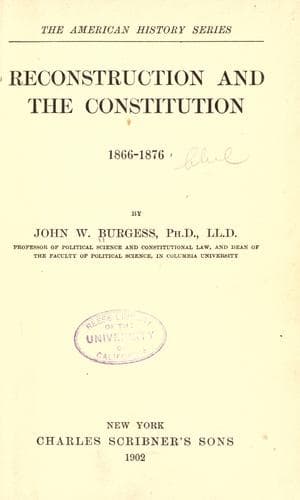
Reconstruction and the Constitution, 1866-1876Burgess, John William
History
Reconstruction and the Constitution, 1866-1876
Burgess, John William
Reconstruction (U.S. history, 1865-1877); United States -- Politics and government -- 1865-1877
him in no other sense than that of an assertion that ten "States" of
the Union were not represented in it, all of which ought to be so
represented when they should send loyal men to take seats therein, and
that he had never intended by this declaration to deny the validity of
the acts of the Congress or its power to originate and adopt an
amendment to the Constitution of the United States.
After the filing of this answer, the counsel of the President asked the
Court of Impeachment for thirty days' time after the replication of the
House of Representatives to this answer should be filed for the
preparation of the President's case. But the managers on the part of
the House again very ungenerously opposed giving them any time at all
for this purpose. The debate over this point lasted until after the
replication of the House was filed on the following day, that is on the
24th of March. The Court of Impeachment then decided to give them until
March 30th, and ordered the trial to proceed on that day.
[Sidenote: The replication of the House to the President's answer.]
The replication filed by the House of Representatives, on the 26th, was
an exception to the answer of the President as insufficient, a denial
of all the averments of the answer, a declaration of the guilt of the
President of the high crimes and misdemeanors charged, and an offer to
prove the same.
{181} [Sidenote: The trial.]
[Sidenote: Conduct of the managers.]
On the 30th, the trial opened with the fierce, not to say brutal,
attack of Mr. Butler on the President. During the entire course of the
trial, from the 30th of March until the 16th of May, the managers
followed a line of conduct which no impartial student of this day can
fail to condemn, and which, even in that time of hostile passion
against the President, lost to them a large measure of popular favor.
They tried to prevail upon the Court of Impeachment to regard itself as
a political body instead of a court, to renounce all limitations upon
its powers, and to accept common rumors against the President as good
evidence of his guilt. On the other hand, they objected to the
introduction of evidence by the President to prove the purpose of his
acts, and to show the advice upon which he had proceeded in their
commission. They succeeded in inducing the Court of Impeachment to
refuse to hear the President's evidence upon these points, although the
Chief Justice had ruled in favor of its reception. There is no doubt
that their cause was greatly weakened in the public esteem by this
manifestation of partisanship on the part of the court.
[Sidenote: The evidence in the case.]
Public-domain text, read in full here on John Shaqi.
Reviews
Reviews
No reviews yet
Be the first to share your thoughts on this work.
Elsewhere in the archive
Join the Discussion
Join the discussion
Sign in to leave a comment or review.
Sign InorCreate an account