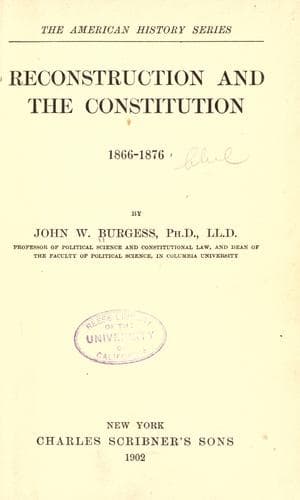
Reconstruction and the Constitution, 1866-1876Burgess, John William
History
Reconstruction and the Constitution, 1866-1876
Burgess, John William
Reconstruction (U.S. history, 1865-1877); United States -- Politics and government -- 1865-1877
The evidence in the case showed no conspiracy with Thomas to do
anything, and no orders to him to use any force in what he was
authorized to do, and no attempt to induce General Emory to violate any
law or any orders received from or through the General of the Army or
any other legal authority. The case, thus, rested chiefly upon the
question as to whether the President had violated the Tenure-of-Office
Act; and the transactions of the President in regard to this subject
were matters of record.
[Sidenote: The argument.]
When one, at this lapse of time from the events, peruses the calm,
dignified, convincing and masterful arguments of the President's
counsel, and compares {182} them with the passionate, partisan
harangues of the managers, it is very difficult to understand how the
latter could have made any serious impression at all. There was only a
single point upon the law seemingly involved in the case in regard to
which they held the better reason. That was the claim on their part
that the President had no right to violate an act of Congress for the
purpose of testing its validity before the United States courts, or for
any other purpose. They argued with much force that to allow the
President the power to violate an act of Congress, or to omit to
execute an act of Congress, in order to make up an issue before the
courts upon the question of its constitutionality, would be virtually
to attribute to the President the once hated royal power of suspending
the law at the pleasure of the Executive. They contended that the veto
power was placed in the hands of the President for the purpose of
allowing him to be heard at the proper time, and to act at the proper
time, in regard to the passage of any law, and that no other power was
given him in relation to the subject; that after he had exhausted this
power, he was bound to execute the legislation of Congress, and could
not suspend it or violate it for any purpose whatsoever; and that the
constitutionality of any of the acts of Congress could be raised before
the courts only by persons not charged with the execution of the law
and having such interests affected by the act in question as would
warrant a judicial procedure.
Public-domain text, read in full here on John Shaqi.
Reviews
Reviews
No reviews yet
Be the first to share your thoughts on this work.
Elsewhere in the archive
Join the Discussion
Join the discussion
Sign in to leave a comment or review.
Sign InorCreate an account