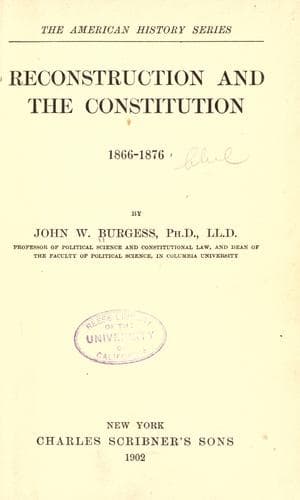
Reconstruction and the Constitution, 1866-1876 — John Shaqi
Reconstruction and the Constitution, 1866-1876Burgess, John William
History
Reconstruction and the Constitution, 1866-1876
Burgess, John William
Reconstruction (U.S. history, 1865-1877); United States -- Politics and government -- 1865-1877
Congress was, however, by this time becoming convinced that
Reconstruction was a legislative problem, that is, a problem to be
solved by Congressional acts and constitutional amendment. This is
evidenced not only by the fact that neither House would admit
representatives from Arkansas elected under the new "State"
organization to seats, but by the more pronounced attitude expressed in
what is known as the Wade-Davis measure upon the direct question at
issue. These gentlemen, Mr. Benjamin F. Wade and Mr. Henry Winter
Davis, the former the chairman of the "Committee on the Rebellious
States" in the Senate, and the latter the chairman of a committee
having the same name and functions in the House, originated a bill and
carried it through both Houses of Congress, which, for the first time,
embodied the views of Congress on the subject of Reconstruction. This
bill was finally passed on July 4, 1864, and it contained provisions of
the following tenor: The eleven "States" which had passed {16}
secession ordinances were all treated as rebellious communities, and
the President was authorized to appoint a provisional governor for
each. This governor should exercise all the powers of civil government
in the community to which he might be appointed until "State"
government should be recognized by Congress as restored therein. An
oath of future allegiance to the Constitution of the United States was
then prescribed, and the provisional governor in each "State" was
ordered, whenever rebellion in his "State" should be suppressed, to
direct the United States Marshal to enroll all the white male citizens
of the United States, resident within the "State," in the respective
counties of the "State," and give them the opportunity to take the oath
of allegiance to the United States. The bill then directed that when a
majority of such citizens should take this oath, they might be
permitted to elect delegates to a convention, which convention might
take action for the establishment of "State" government. The bill
disqualified all persons who had held any office, civil or military,
"State" or Confederate, in rebellion against the United States, or who
had voluntarily borne arms against the United States, from voting for
delegates, or from being elected as delegates, to the convention. The
bill then provided that the convention thus elected and assembled might
form a "State" constitution, but must insert in it clauses abolishing
slavery, repudiating all debts, "State" or Confederate, created by, or
under the sanction of, the usurping power, and disqualifying all
persons who had held office civil or military, "State" or Confederate,
under the usurping power, except civil offices merely ministerial, and
military offices below the rank of colonel, from voting or being
elected governor or members of the legislature. The bill then provided
for the submission of the constitution so formed to the voters, {17}
and if ratified by a majority thereof, required the provisional
Public-domain text, read in full here on John Shaqi.
Reviews
Reviews
No reviews yet
Be the first to share your thoughts on this work.
Join the Discussion
Join the discussion
Sign in to leave a comment or review.
Sign InorCreate an account