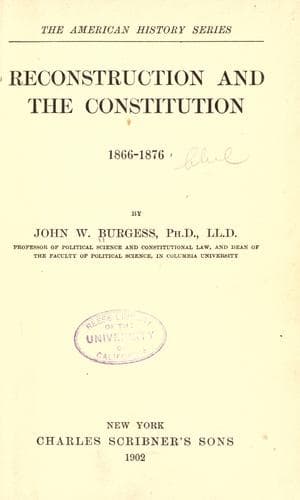
Reconstruction and the Constitution, 1866-1876Burgess, John William
History
Reconstruction and the Constitution, 1866-1876
Burgess, John William
Reconstruction (U.S. history, 1865-1877); United States -- Politics and government -- 1865-1877
governor to certify the same to the President. It then provided that
the President, after obtaining the consent of Congress thereto, should
proclaim the new "State" government as established, and as the
constitutional government of the "State," after which Representatives
and Senators in Congress, and electors of the President, might be
chosen in said "State." Finally, the bill abolished slavery at once in
all the rebellious "States" and imposed penalties upon all persons
attempting thereafter to hold anyone in involuntary servitude; and
declared all persons who should thereafter hold office civil or
military, "State" or Confederate, in the rebel service, except an
office purely ministerial or under the grade of colonel, not to be
citizens of the United States.
[Sidenote: Analysis of this measure.]
A brief analysis of this bill will show that Congress was nearer to
some doctrine on the subject of Reconstruction than was the President.
In the first place, Congress claimed Reconstruction as a legislative
problem. This was undoubtedly the true theory upon that point. In the
second place, Congress required the loyalty to the United States of at
least a majority of the white adult males as the basis of "State"
government, local self-government. That also was undoubtedly true
political theory as has been already explained. In the third place,
Congress asserted the power to abolish slavery within the limits of
those "States" whose legislatures or conventions had passed the
ordinances of secession. That is, Congress dealt with these districts
not as "States" of the Union, but as territories or districts subject
to the exclusive authority of the central Government. Congress was here
beginning, at least, to act upon the idea that the districts in
rebellion did not perdure, as "States," {18} throughout the rebellion,
but had lost thereby the forms, powers and functions of "State"
governments, and were neither out of the Union nor in the Union as
"States," but were under the central Government of the Union as
territory inhabited by a population disorganized as to local
government. This was also sound political science, and the President
ought to have heeded its teachings.
[Sidenote: The President's attitude toward the bill.]
[Sidenote: The President's proclamation of July 8, 1864.]
Public-domain text, read in full here on John Shaqi.
Reviews
Reviews
No reviews yet
Be the first to share your thoughts on this work.
Join the Discussion
Join the discussion
Sign in to leave a comment or review.
Sign InorCreate an account