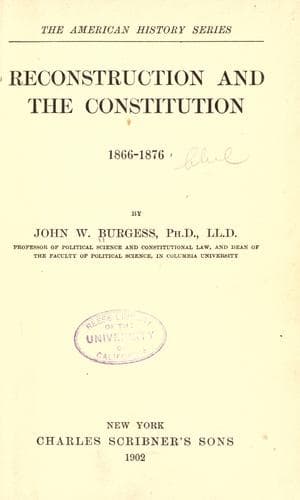
Reconstruction and the Constitution, 1866-1876 — John Shaqi
Reconstruction and the Constitution, 1866-1876Burgess, John William
History
Reconstruction and the Constitution, 1866-1876
Burgess, John William
Reconstruction (U.S. history, 1865-1877); United States -- Politics and government -- 1865-1877
But he did not. He did not, it is true, veto the bill. He simply
allowed the session to expire without signing it. This having happened
in less than ten days from the time it was submitted to him, the bill
failed, as provided in such cases by the Constitution. He, however,
issued on the 8th of July a proclamation in regard to the subject, in
which he objected to the setting aside of the "free State constitutions
and governments already adopted and installed in Arkansas and
Louisiana;" doubted the competency of Congress to abolish slavery
within the "States;" expressed the hope and expectation that this might
be done for the whole country by constitutional amendment; declared his
willingness to have the loyal people in any of the rebellious "States"
reconstruct their governments upon the Congressional plan, if they
should choose to do so; but declared also his unwillingness to commit
himself inflexibly to any single plan of restoration; and virtually
asked the voters to make the difference between himself and Congress
upon the subject an issue in the coming Presidential election.
[Sidenote: The Wade-Davis protest against the President's
proclamation.]
This was one of the boldest acts of Mr. Lincoln's career as President,
and it is little wonder that men of so much intelligence, courage and
tenacity as Messrs. Wade and Davis did not allow the proclamation to go
unanswered. Congress had adjourned, as we have seen, before the
appearance of the proclamation. There was, {19} therefore, no way for
Congress as a whole to make immediate answer. Messrs. Wade and Davis
believed that the public interests would suffer if the answer should be
postponed until the next meeting of Congress. They, therefore, issued a
protest against the proclamation over their own names. The protest was
printed in the New York _Tribune_ of August 5, 1864. It was an
intemperate arraignment of the President. It declared, among other
things, that "a more studied outrage on the legislative authority of
the people had never been perpetrated;" that the President had "greatly
presumed on the forbearance which the supporters of his Administration"
had "so long practised, in view of the arduous conflict in which" they
were "engaged and the reckless ferocity of" their "political
opponents;" that he must understand that their support was not of a man
but of a cause; and that he must confine himself to his executive
duties, and leave political reorganization to Congress.
Such denunciations of the President's purposes could have but one
effect, viz., the strengthening of his hands by the support of the
people, who so generally trusted him, in the election of 1864. It
injured Mr. Davis so much that he failed of even a renomination for his
seat in Congress.
[Sidenote: The President's message of December 6, 1864.]
Public-domain text, read in full here on John Shaqi.
Reviews
Reviews
No reviews yet
Be the first to share your thoughts on this work.
Join the Discussion
Join the discussion
Sign in to leave a comment or review.
Sign InorCreate an account