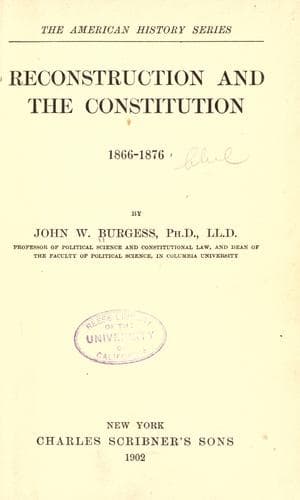
Reconstruction and the Constitution, 1866-1876Burgess, John William
History
Reconstruction and the Constitution, 1866-1876
Burgess, John William
Reconstruction (U.S. history, 1865-1877); United States -- Politics and government -- 1865-1877
The Congress passed the Act of the 28th of February, 1871, which so
supplemented the Act of May 31st, 1870, as to place the whole control
of the registrations and elections when and where Representatives to
Congress should be chosen, in the hands of United States officers, the
supervisors, and the deputy marshals, commissioners and judges of the
United States courts. It may be claimed that Congress, under the power
to regulate the manner of holding Congressional elections vested in it
by Article I., section 4, of the Constitution, was authorized to pass
this law, provided it confined the action of it to the Congressional
registration and election. But since the "State" elections were held at
the same time and place, and under the same control and direction as
the Congressional, it was inevitable that the control of the United
States officers would be exercised, either directly {257} or
indirectly, over those also. And this was unquestionably the chief
purpose of the Act, so far as its execution in the Southern "States"
was concerned.
[Sidenote: The President's Message of March 23d, 1871.]
But this was not yet enough in the views of the Administration. In the
two years of his incumbency of the Presidential office, General Grant
had fallen into the arms of the radical Republicans, who appeared to be
in large majority, and the usual manoeuvering had begun for the second
term. Upon the basis of information, which turned out to be very
insufficient and unreliable, the President, on the 23d of March, 1871,
addressed a message to Congress, in which he affirmed that life and
property were insecure in some of the "States," and the carrying of the
mails and the collection of the revenue dangerous; that the power to
correct these evils was not possessed by the "State" governments; and
that it was doubtful if the Executive of the United States, under
existing laws, had the power to meet these exigencies; and asked
Congress to pass such laws as would enable him to cope with the
situation.
[Sidenote: The Ku-Klux Act of April 20th, 1871.]
Public-domain text, read in full here on John Shaqi.
Reviews
Reviews
No reviews yet
Be the first to share your thoughts on this work.
Elsewhere in the archive
Join the Discussion
Join the discussion
Sign in to leave a comment or review.
Sign InorCreate an account