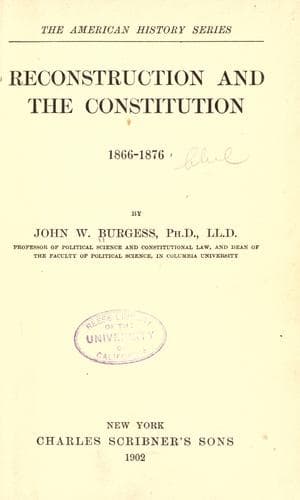
Reconstruction and the Constitution, 1866-1876Burgess, John William
History
Reconstruction and the Constitution, 1866-1876
Burgess, John William
Reconstruction (U.S. history, 1865-1877); United States -- Politics and government -- 1865-1877
The case of Tennessee did not from this point of view appear as strong
as that of Louisiana. But it is difficult to see how the Republicans
could have consistently rejected the vote of Tennessee after having
nominated and elected a citizen of Tennessee as Vice-President of the
United States. It is certainly implied in the Constitution of the
United States that no man is {24} eligible to the office of
Vice-President unless he be at the time of his election a citizen of a
"State" of the Union. The Constitution implies that the Vice-President
shall have the same qualifications as the President; and it distinctly
says that in giving their vote, the electors in each "State" shall vote
for two persons, "of whom one at least shall not be an inhabitant of
the same State with themselves." If an inhabitant of Tennessee could be
lawfully Vice-President of the United States, it does certainly seem
implied that Tennessee was, at the time, a "State" of the Union in
regular standing.
However this may have been, the President was certainly correct in
saying that Congress was vested with full power over the count of the
electoral vote, and that the Executive had no control over it
whatsoever. It was a bit of harmless good humor that he signed the
resolution as a perfunctory matter, and it was calculated to improve
the temper of the somewhat irritated members of Congress.
[Sidenote: The twenty-second joint rule.]
Congress was not, however, formally notified of the fact that he had
signed the measure until after the counting of the vote had been
finished, and the two Houses met the exigency by the enactment of what
was known as "the twenty-second joint rule," according to which the
consent of both Houses was required to count the electoral vote from
any "State" or any body or place professing to be a "State." As a
matter of fact, the Vice-President, Mr. Hamlin, declared that he had in
his possession returns from the "States" of Louisiana and Tennessee,
but held it to be his duty not to present them, and he did not present
them. He knew that the President had signed the joint resolution,
although Congress had not been officially notified of it, and he acted
under the {25} resolution as law. The joint rule would have required
the presentation of these votes to the joint meeting of the two Houses,
and would have required the concurrence of the two Houses, acting
separately, to have included them in the count. The joint rule was,
therefore, not applied to the case for which it was enacted, but it
remained unrepealed for more than ten years, and then showed itself a
sort of Nemesis to its creators.
[Sidenote: Reconstruction in Tennessee continued.]
Public-domain text, read in full here on John Shaqi.
Reviews
Reviews
No reviews yet
Be the first to share your thoughts on this work.
Join the Discussion
Join the discussion
Sign in to leave a comment or review.
Sign InorCreate an account