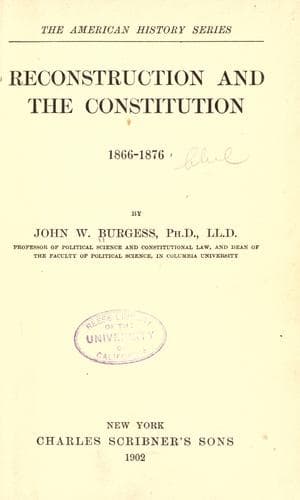
Reconstruction and the Constitution, 1866-1876 — John Shaqi
Reconstruction and the Constitution, 1866-1876Burgess, John William
History
Reconstruction and the Constitution, 1866-1876
Burgess, John William
Reconstruction (U.S. history, 1865-1877); United States -- Politics and government -- 1865-1877
Tennessee pursued, however, the course of reconstruction upon which she
had set out. Her test oath, as we have seen, required virtually that
the basis of her reorganization should be the men who had _remained_
loyal throughout the rebellion. It differed thus from Mr. Lincoln's
oath, which rehabilitated those who would promise future loyalty. The
vote in favor of the new constitution, which was the old constitution
of the "State" amended by articles abolishing slavery, nullifying
secession, and repudiating the debt created in aid of the rebellion,
was more than twenty-five thousand, nearly twenty per centum of the
vote for Presidential electors in 1860. This certainly much more than
fulfilled all of Mr. Lincoln's conditions.
[Sidenote: Civil government re-established in Tennessee.]
Governor Johnson issued his proclamation on February 25th, 1865,
declaring the adoption of the new constitution, and ordering the
election of the Governor and legislative members under it for March
4th. W. G. Brownlow was chosen Governor. The newly elected legislature
did not meet, however, until April 2d, and Mr. Brownlow was not
inaugurated as civil Governor until April 7th. As Mr. Johnson was
inaugurated Vice-President on March 4th, he had been obliged to lay
down the military governorship on that date, in fact, a few days
before, and Mr. Brownlow had been appointed {26} in his stead. Upon
Brownlow's inauguration as civil Governor, the military régime in
Tennessee was formally ended. Lincoln acquiesced certainly in this
change.
It remained now for Congress to show its attitude, when the Senators
and Representatives from Tennessee should present themselves for
admission to seats in the two Houses. As this could not happen until
the following December, the history of this point must be deferred
until the events between March 4th and December 4th are related.
[Sidenote: The Thirteenth Amendment to the Constitution of the United
States.]
The experiences of the year 1863 with the slavery problem had convinced
the President and the leaders of the Republican party in Congress that
abolition must be effected by a constitutional amendment. The military
acts of the President in this direction were, as all the purely
military measures of the Executive, temporary, and with the
re-establishment of peace would cease to have force; and it was by this
time pretty clear that but few of the "States" would abolish slavery by
their own act. Already on January 11, 1864, had the proposition for a
constitutional amendment abolishing slavery throughout the length and
breadth of the United States been presented in the Senate by Mr. John
B. Henderson of Missouri, and referred to the Judiciary Committee of
that body for consideration and report.
Public-domain text, read in full here on John Shaqi.
Reviews
Reviews
No reviews yet
Be the first to share your thoughts on this work.
Join the Discussion
Join the discussion
Sign in to leave a comment or review.
Sign InorCreate an account