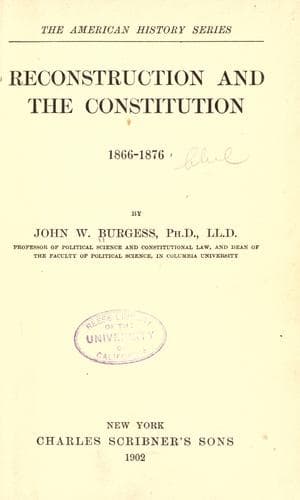
Reconstruction and the Constitution, 1866-1876Burgess, John William
History
Reconstruction and the Constitution, 1866-1876
Burgess, John William
Reconstruction (U.S. history, 1865-1877); United States -- Politics and government -- 1865-1877
The Character of Mr. Johnson--The Radical Nature of Johnson's First
Views on Reconstruction--The Retention of Lincoln's Cabinet by Mr.
Johnson and the Modification of Johnson's Views by Mr. Seward's
Arguments--Johnson's Amnesty Proclamation of May 29th, 1865--The
Excepted Classes--The Effect of these Exceptions--The President's
Plan--The Realization of it--The Administering of the
Oath--Reconstruction in North Carolina--The Identity of Johnson's Plan
with that of Lincoln--Reconstruction in Mississippi--Reconstruction in
Georgia--Reconstruction in Alabama, South Carolina and
Florida--Reconstruction in Virginia--Reconstruction in Louisiana,
Arkansas and Tennessee--The Constitutional Conventions of 1865--The
Form of the Work Done in these Conventions, and its Substance--The
Erection of "State" Governments and the Election of Members of
Congress--The Orders of the President Putting the Civil Government of
the United States into Operation Everywhere--The President's First
Annual Message.
[Sidenote: The character of Mr. Johnson.]
Mr. Johnson was a man who rose from very low estate through his own
efforts. He was a man of considerable intellectual power and of great
will power. He was somewhat vain of his success and somewhat piqued by
the social neglect which he had suffered at the hands of the "old
families." He was intensely loyal to the Union, and could regard
secession and rebellion only as treason. Having suffered so much for
his loyalty, he was somewhat moved by considerations of revenge. He was
profoundly stirred by {32} the assassination of Lincoln, and apparently
believed it to have been planned by those high in authority in the
Confederacy; and he was possessed with an intense desire to
re-establish the Union on an enduring foundation.
[Sidenote: The radical nature of Johnson's first views on
Reconstruction.]
With such a history behind him, and such a disposition impelling him,
it is not to be wondered at that his policy in regard to Reconstruction
should have been more stringent than that of Mr. Lincoln. In fact it
was feared, even by the more radical Republicans, such, for instance,
as Mr. Wade, that he would be bloody minded in the treatment of the
rebel chiefs. He had, before his accession to the Presidency, declared
so often, and so vehemently, that "traitors should be arrested, tried,
convicted and hanged," that most men were expecting the strict
application of the criminal law to the Confederate leaders.
[Sidenote: The retention of Lincoln's Cabinet by Mr. Johnson, and the
modification of Johnson's views by Mr. Seward's arguments.]
Public-domain text, read in full here on John Shaqi.
Reviews
Reviews
No reviews yet
Be the first to share your thoughts on this work.
Join the Discussion
Join the discussion
Sign in to leave a comment or review.
Sign InorCreate an account