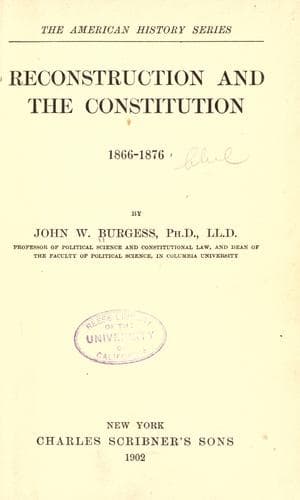
Reconstruction and the Constitution, 1866-1876Burgess, John William
History
Reconstruction and the Constitution, 1866-1876
Burgess, John William
Reconstruction (U.S. history, 1865-1877); United States -- Politics and government -- 1865-1877
Mr. Johnson retained Lincoln's Cabinet, and among them the conciliatory
and persuasive Seward, who, in about six weeks from the night of the
assassination, at which time he himself was seriously wounded, returned
to his work in the State Department. There is no doubt that it was the
influence of Seward which modified the views and purposes of Mr.
Johnson. The compliant spirit manifested at this time by the
Confederate chiefs helped strongly in the same direction. By the 1st of
June, Seward had won Johnson completely for his plan of a rapid and
forgiving reconstruction by the Executive. Congress was not in session,
and the President was not inclined to call an extra session. The late
rebel chieftains were pressing for the political rehabilitation of
their section, and the President now fully believed that he had the
power to proceed with the problem of Reconstruction, and was inclined
to do so.
{33} [Sidenote: Johnson's Amnesty Proclamation of May 29, 1865.]
On the 29th of May, he issued his proclamation of amnesty and pardon to
all persons who, having engaged in rebellion, had failed to take the
benefits of Mr. Lincoln's proclamations of December 8, 1863, and March
26, 1864. To all such persons Mr. Johnson offered his pardon upon their
taking an oath of the following tenor: "I ---- do solemnly swear (or
affirm) in the presence of Almighty God, that I will henceforth
faithfully support, protect, and defend the Constitution of the United
States and the Union of the States thereunder, and that I will in like
manner abide by and faithfully support all laws and proclamations which
have been made during the existing rebellion with reference to the
emancipation of slaves. So help me God."
[Sidenote: The excepted classes.]
He, however, excepted the following classes of persons from the
benefits of the offer: 1st. Those who held or had held, under the
pretended Confederate Government, civil or diplomatic office or agency,
or military office above the rank of colonel in the army and lieutenant
in the navy, or military or naval office of any grade, if educated by
the United States Government in the Military Academy at West Point or
the United States Naval Academy; and all those who held, or had held,
the pretended office of Governor of a "State" in insurrection against
the United States;
2d. Those who had left seats in the Congress of the United States or
judicial stations under the United States to aid in the rebellion
against the United States, and those who had resigned or tendered
resignations of their commissions in the army or navy of the United
States to evade duty in resisting the rebellion;
3d. Those who had, in any way, treated persons found in the service of
the United States, in any capacity, otherwise than lawfully as
prisoners of war;
Public-domain text, read in full here on John Shaqi.
Reviews
Reviews
No reviews yet
Be the first to share your thoughts on this work.
Join the Discussion
Join the discussion
Sign in to leave a comment or review.
Sign InorCreate an account