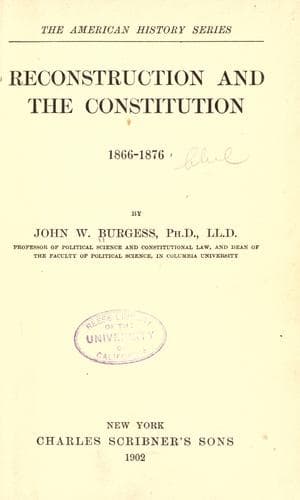
Reconstruction and the Constitution, 1866-1876Burgess, John William
History
Reconstruction and the Constitution, 1866-1876
Burgess, John William
Reconstruction (U.S. history, 1865-1877); United States -- Politics and government -- 1865-1877
{34} 4th. Those who had been engaged in destroying the commerce of the
United States on the high seas, or upon the lakes and rivers separating
the British Provinces from the United States, or in making raids from
Canada into the United States;
5th. Those who were, or had been, absent from the United States, or had
left their homes within the jurisdiction of the United States, and
passed beyond the military lines of the United States into the
pretended Confederate States, for the purpose of aiding the rebellion;
6th. Those who, at the time they might seek to obtain the benefits of
the proclamation by taking the oath, were prisoners of war, or under
civil or criminal arrest, and those who had taken the oath of
allegiance to the United States since December 8, 1863, and had failed
to keep it;
And, finally, those who had voluntarily participated in any way in the
rebellion and were the owners of taxable property to the value of more
than twenty thousand dollars.
[Sidenote: The effect of these exceptions.]
These exceptions would have shut out almost all of the leading men of
most of the "States" that passed secession ordinances from the benefits
of the proclamation, except for the subsequent provision in the
proclamation, which ordained that special application might be made to
the President for pardon by any person belonging to the excepted
classes, and held out the promise that such clemency would be as
liberally extended as might be consistent with the facts of the case
and the peace and dignity of the United States.
[Sidenote: The President's plan in a sentence.]
Briefly, the President proposed to pardon the rebel leaders, upon
special personal application, as an act of high executive grace, and to
amnesty every one else in a body; and upon the basis of {35} their
re-established loyalty to use the old electorate of the South in
reconstruction. How he succeeded we will now proceed to relate.
[Sidenote: The realization of it.]
[Sidenote: The administering of the oath.]
In the first place, the machinery for administering the cleansing oath
was made very simple and accessible. Any commissioned officer, civil,
military or naval, of the United States, and any officer, civil or
military, of a loyal "State" qualified by the laws of the "State" to
administer oaths, was declared by the President, through his Secretary
of State, to be competent to administer this oath of loyalty, a copy of
which should be given to the person taking it as his certificate of
restored citizenship, and another copy sent to the State Department at
Washington to be there deposited and kept in the archives of the
Government.
[Sidenote: Reconstruction in North Carolina.]
Public-domain text, read in full here on John Shaqi.
Reviews
Reviews
No reviews yet
Be the first to share your thoughts on this work.
Join the Discussion
Join the discussion
Sign in to leave a comment or review.
Sign InorCreate an account