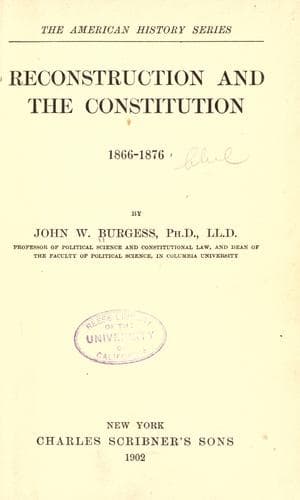
Reconstruction and the Constitution, 1866-1876Burgess, John William
History
Reconstruction and the Constitution, 1866-1876
Burgess, John William
Reconstruction (U.S. history, 1865-1877); United States -- Politics and government -- 1865-1877
It provided, further, for the intermarriage of freedmen, free negroes
and mulattoes, and for the legalization of all previous and existing
cohabitations between them, and the legitimation of the issue
therefrom; but it forbade intermarriage between them and white persons,
under penalty of life imprisonment, and it defined freedmen, free
negroes and mulattoes as comprehending all of pure negro blood, and all
descended from negroes to the third generation inclusive, although one
parent in each generation should have been white.
It provided, further, that freedmen, free negroes and mulattoes should
be competent as witnesses in all civil cases, in which they themselves
or other freedmen, free negroes and mulattoes were parties or a party
to the suit, and in criminal cases where the crime charged was alleged
to have been committed by a white person or persons upon or against the
person or property of a freedman, free negro, or mulatto.
It provided, further, that every freedman, free negro and mulatto
should have a lawful home and employment, and should have written
evidence thereof in the form of a license from the police authorities
to do irregular or job work, or in the form of a written contract for
labor. It required that all contracts made with freedmen, free negroes
and mulattoes for labor for a longer period than one month should be in
writing, a copy of which should be furnished to each party, and that if
the laborer should quit the service of the employer before the
expiration of the term fixed in the contract, he should forfeit his
wages for that year up to the time of quitting.
It provided, further, for the arrest of any freedman, free negro, or
mulatto quitting the service of an employer, and for the determination
of the question whether {51} the quitting was for good cause or not,
and for the disposition to be made of the deserter.
It provided, further, that enticing or persuading freedmen, free
negroes or mulattoes to desert from their legal employment, or
employing deserters from contract labor knowingly, or giving or selling
them food, raiment or other thing knowingly, should be a misdemeanor
punishable by fine, or by imprisonment in case the fine should not be
paid.
It provided, further, that no freedman, free negro or mulatto, unless
in the military service of the United States, or licensed thereto by
the police authorities, should keep or carry arms, ammunition or
murderous weapons, and that every civil and military officer should
arrest any such person found in possession of such articles, and commit
him for trial.
Public-domain text, read in full here on John Shaqi.
Reviews
Reviews
No reviews yet
Be the first to share your thoughts on this work.
Join the Discussion
Join the discussion
Sign in to leave a comment or review.
Sign InorCreate an account