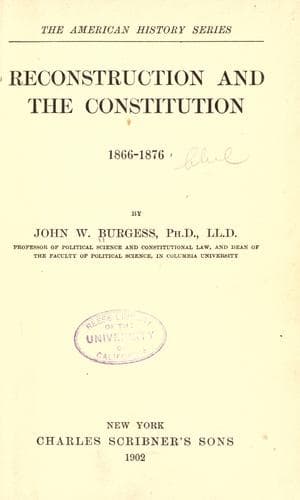
Reconstruction and the Constitution, 1866-1876 — John Shaqi
Reconstruction and the Constitution, 1866-1876Burgess, John William
History
Reconstruction and the Constitution, 1866-1876
Burgess, John William
Reconstruction (U.S. history, 1865-1877); United States -- Politics and government -- 1865-1877
It provided, further, that "any freedman, free negro, or mulatto
committing riots, affrays, trespasses, malicious mischief and cruel
treatment to animals, seditious speeches, insulting gestures, language
or acts, or assaults on any person, disturbance of the peace, or
exercising the functions of a minister of the gospel without a license
from some regularly organized church, or selling spirituous or
intoxicating liquors, or committing any other misdemeanor," should be
fined or imprisoned, and, upon failure to pay the fine in five days'
time after conviction, should be publicly hired out to the person who
would pay the fine and costs for the shortest term of labor from the
convict.
And it provided, finally, that "all the penal and criminal laws now in
force in this State, defining offences, and prescribing the mode of
punishment for crimes and misdemeanors committed by slaves, free
negroes or mulattoes, be and the same are hereby re-enacted, and
declared to be in full force and effect, against {52} freedmen, free
negroes and mulattoes, except so far as the mode and manner of trial
and punishment have been changed or altered by law."
[Sidenote: The Mississippi legislation a fair sample of the subsequent
legislation in other "States."]
This is a fair sample of the legislation subsequently passed by all the
"States" reconstructed under President Johnson's plan. In fact, in the
legislatures of several of them, bills containing substantially these
provisions were under consideration when Congress met, and it was fair
to suppose that they would be enacted. Congress had thus in the first
week of December, 1865, substantially before it what the reconstructed
"States" proposed to do in reference to the status and rights of the
former slaves, and in reference to the relations between the negro and
the white man in the future.
As yet, we must remember, the Thirteenth Amendment had not been
proclaimed as adopted, in fact had not been adopted, on the basis of
the calculations of Mr. Seward, the Secretary of State, the officer who
alone could proclaim adoption; and the abolition of slavery rested upon
the military power of the President, and on the acts of the "States"
themselves, the first of which is temporary as to its effects, and the
second of which might be reversed by the "States" at pleasure.
[Sidenote: The view taken of this legislation by the Republicans.]
[Sidenote: This legislation from the point of view of natural justice.]
Public-domain text, read in full here on John Shaqi.
Reviews
Reviews
No reviews yet
Be the first to share your thoughts on this work.
Join the Discussion
Join the discussion
Sign in to leave a comment or review.
Sign InorCreate an account