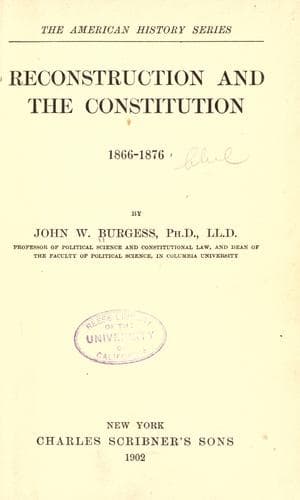
Reconstruction and the Constitution, 1866-1876 — John Shaqi
Reconstruction and the Constitution, 1866-1876Burgess, John William
History
Reconstruction and the Constitution, 1866-1876
Burgess, John William
Reconstruction (U.S. history, 1865-1877); United States -- Politics and government -- 1865-1877
Mr. Stevens opened this debate in the House on the 18th of December
(1865). In a powerful speech, he developed anew his doctrine that the
territory once covered by the "States," which had seceded from the
Union, was nothing now but a conquered district, whose future condition
depended upon the will of the conqueror. If "States" should ever be
erected there again, it must be accomplished, he contended, by virtue
of that provision in the Constitution which declares that "new States
may be admitted by Congress into this Union." This theory involved the
admission that secession had been temporarily successful. This Mr.
Stevens frankly acknowledged. He said: "Unless the law of nations is a
dead letter, the late war between the two acknowledged belligerents
severed their original contracts, and broke all the ties that bound
them together."
[Sidenote: Contradiction between Stevens's view and the view of the
Administration.]
This was the extreme doctrine on the one side. It was in blunt
contradiction to the doctrine upon which the Administration was acting,
the doctrine that the attempt at secession was entirely abortive, and
that the "States" where it was attempted were still in the Union _as
"States,"_ and had never been anywhere else or anything else, in fact
could not be; that the rebellion was the work of private individuals
combined as truly against the real "States" in which it existed as
against the {59} United States; and that, therefore, the overthrow of
these combinations and the cessation of the military rule of the
President must be followed by the resumption on the part of the
"States" concerned of all their rights and powers of local
self-government and of participation in the United States Government,
as guaranteed by the Constitution of the United States, unimpaired, and
without any action whatever on the part of Congress. Mr. Raymond
represented this view on the floor of the House of Representatives. He
was a Republican of the Seward school, and sympathized entirely with
his patron upon this subject. It was a great embarrassment to him that
the Democrats immediately gave in their adherence to this view. It
helped to prevent him from gaining any following at all for it among
the Republicans.
But while the Republicans of the House repudiated entirely Mr.
Raymond's principles, the great mass of them were not able to accept
Mr. Stevens's view of the temporary validity of secession, and the
temporary existence of the Southern Confederacy as a foreign power.
Their feelings and instincts required a principle of reconstruction
which, at the same time that it did not recognize secession as having
any validity for the shortest moment, yet regarded the "States" in
which it was attempted, as having thereby become something other than
"States" of the Union, and as requiring the assent of Congress to the
rightful resumption of that status.
[Sidenote: Mr. Shellabarger's theory of Reconstruction.]
Public-domain text, read in full here on John Shaqi.
Reviews
Reviews
No reviews yet
Be the first to share your thoughts on this work.
Join the Discussion
Join the discussion
Sign in to leave a comment or review.
Sign InorCreate an account