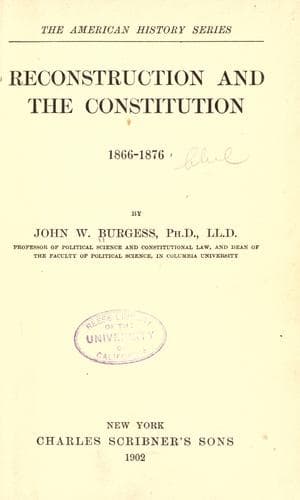
Reconstruction and the Constitution, 1866-1876Burgess, John William
History
Reconstruction and the Constitution, 1866-1876
Burgess, John William
Reconstruction (U.S. history, 1865-1877); United States -- Politics and government -- 1865-1877
It was Mr. Shellabarger, of Ohio, who did more than anybody else to
give the proper logical interpretation to these feelings and invent the
theory of Reconstruction on which the Republicans could plant
themselves. Briefly stated that theory was that, while secession was a
nullity legally from the beginning, and could not take the territory
{60} occupied by the "States" attempting it, or the people inhabiting
that territory, out of the Union, or from under the rightful
jurisdiction of the United States Government and Constitution for one
instant, yet it worked the loss of the "State" status in the Union, and
from a legal point of view left this territory and the inhabitants of
it subject exclusively to the jurisdiction of the United States
Government, a status from which they could be relieved only by the
erection of "States" anew upon such territory, an operation which could
be effected, under the Constitution of the United States, only by the
co-operation of Congress with the loyal inhabitants of such territory.
[Sidenote: Mr. Sumner's theory of Reconstruction.]
[Sidenote: The Republicans in Congress almost unanimously in favor of
the Shellabarger-Sumner plan.]
This was sound political science and correct constitutional law. It
could not fail to command the assent of the great majority of the
Republicans in the House and in the country. This same doctrine was, at
the same time, developed in the Senate by Mr. Sumner, Mr. Fessenden and
Mr. Wilson, and it was easy to see that it had become the theory of the
Republican party in Congress long before the final report of the
Committee on Reconstruction promulgated it. Even Stevens and his
radical followers were in line with it in so far as practical results
were concerned. That is, the Republicans all stood together on the
principle that Reconstruction could only be effected by Congressional
acts, since it was tantamount to a conferring, or reconferring, of the
"State" status upon a population at the moment subject to the exclusive
jurisdiction of the Government of the United States. This meant that
the entire Republican party in Congress, with the exception of the four
members of the Senate already named, and of Mr. Raymond and one other
in the House (and this constituted a majority of two-thirds in each
House) would antagonize the plan of Executive Reconstruction {61}
devised by Lincoln and Seward and persisted in by Johnson and, to that
moment, by his cabinet. How far the Republicans in Congress would go in
the attempt to set aside Executive Reconstruction depended chiefly upon
the moderation of the President, and the sincerity of the people in the
South. It depended also in some degree, to say the least, upon what
would be necessary to keep the Republican party, which conceived itself
to be the only really loyal party to the Union, in power.
Public-domain text, read in full here on John Shaqi.
Reviews
Reviews
No reviews yet
Be the first to share your thoughts on this work.
Join the Discussion
Join the discussion
Sign in to leave a comment or review.
Sign InorCreate an account