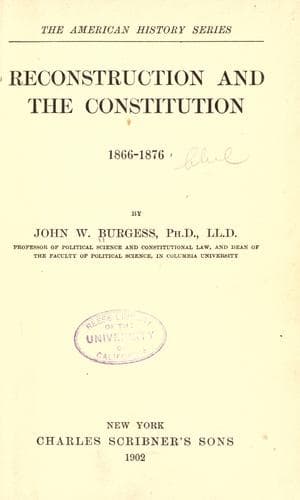
Reconstruction and the Constitution, 1866-1876 — John Shaqi
Reconstruction and the Constitution, 1866-1876Burgess, John William
History
Reconstruction and the Constitution, 1866-1876
Burgess, John William
Reconstruction (U.S. history, 1865-1877); United States -- Politics and government -- 1865-1877
Second, While in the law of March 3d, 1865, the Bureau rather appeared
to be under the civil administration of the President, the new bill
placed it distinctly under the military administration of the
President, and authorized the President to extend "military
jurisdiction and protection over all of the officers, agents, and
employees of the Bureau."
Third, While the law of March 3d, 1865, confined the powers of the
Bureau to the giving of aid to {65} refugees and freedmen and the
distribution of abandoned and confiscated lands among them, the new
bill proposed, in addition to this, to vest in the Bureau the power to
build school houses and asylums for the freedmen, and the most
wide-reaching jurisdiction over all civil and criminal cases where
equality in civil rights and status, and in the application of
penalties, was denied, or the denial thereof attempted, on account of
race, color, or previous condition of servitude; and it authorized
military protection in all such cases to be extended to the suffering
party. In a single sentence, this bill provided a sort of palatine
jurisdiction over the freedmen in the section lately the scene of
rebellion.
[Sidenote: The passage of the bill.]
It was a stiff measure even for the transition period from war to
peace. It cannot be justified constitutionally as anything but a war
measure. It is true that the Thirteenth Amendment, just adopted, could
be interpreted as giving Congress the power to prohibit inequalities in
civil rights and in criminal punishments, as the incidents of slavery
or involuntary servitude, and to extend the ordinary jurisdiction of
the constitutional courts of the United States over all cases where the
attempt to apply such inequalities should be made. But it certainly did
not give Congress the power, under any ordinary circumstances, to
create a new system of courts, subject to the Executive, officered by
military men, and armed directly with military power to enforce
decisions. It was, as has been said, a war measure, and nothing else.
The question was reduced simply to this: Ought the Congress of the
United States to enact a new war measure, after armed resistance had
ceased everywhere, except perhaps in some parts of Texas? Was it sound
policy, was it good morals, to do so, when the people in the sections
lately in rebellion were settling down into the pursuits of peace, even
though Congress might {66} legally have the right to do so? The bill
was debated long and carefully in the Senate by all of the leading
members, and the opinion finally prevailed among them that it was a
measure necessary to preserve and protect the freedom of the newly
enfranchised. It passed the Senate by a vote of 37 to 10, and the House
by a vote of 136 to 33.
[Sidenote: The veto upon it.]
Public-domain text, read in full here on John Shaqi.
Reviews
Reviews
No reviews yet
Be the first to share your thoughts on this work.
Join the Discussion
Join the discussion
Sign in to leave a comment or review.
Sign InorCreate an account