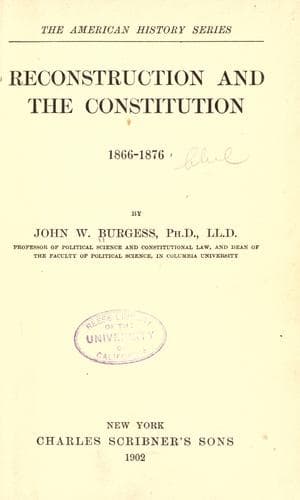
Reconstruction and the Constitution, 1866-1876Burgess, John William
History
Reconstruction and the Constitution, 1866-1876
Burgess, John William
Reconstruction (U.S. history, 1865-1877); United States -- Politics and government -- 1865-1877
The President had sent General Grant and General Carl Schurz on tours
of inspection and inquiry through the South, during the late summer and
autumn of 1865; and Congress now asked the President to impart to it
the information thus gathered. The two reports were quite
contradictory. General Grant said that he drew the conclusion from his
observations that "the mass of thinking men of the South accept the
present situation of affairs in good faith." He also indicated that the
officers of the Freedmen's Bureau were a useless set of men, dangerous
to the peace and prosperity of the South, and recommended that the
military officers in the different districts should be put in charge of
the bureau.
Mr. Schurz, on the other hand, reported that his conclusions from his
observations were that there was no loyalty among the leaders and the
mass of the people in the South, except such as consisted in submission
to necessity; that they were consciously attempting in their new
legislation to establish a new form of slavery, distinct only from the
old chattel slavery; and that this could be prevented only by national
law and national control, at least for many years to come.
General Grant's visit had been a flying one, and his inquiries upon the
subject were secondary only to his other business. On the other hand,
General Schurz had journeyed deliberately, and his inquiries were the
chief, if not the sole, purpose of his visit. Moreover, {64} General
Schurz was a keener observer in regard to such matters than General
Grant, and a much better reasoner.
[Sidenote: The attitude of Congress toward the reports.]
Despite, therefore, the great popularity and influence of General
Grant, Congress was inclined to place more credence in the report of
General Schurz. While its Committee on Reconstruction was deliberating,
it, therefore, most naturally set itself about doing what it could,
under the Thirteenth Amendment, and also under its still existing war
powers, in behalf of the civil rights of the freedmen.
[Sidenote: The Freedmen's Bureau bill of 1866.]
The first measure it attempted was one to enlarge the powers of the
Freedmen's Bureau. This supplementary project originated with the
Judiciary Committee of the Senate, and was presented in the Senate on
the 12th of January, 1866. The new bill proposed to increase the
personnel of the bureau and expand the powers vested in it as provided
in the law of March 3d, 1865, in the following most important respects:
First, While the law of March 3d, 1865, provided for the appointment of
a commissioner and ten assistants as the entire personnel of the
Bureau, the new bill authorized the appointment of a commissioner,
twelve assistant commissioners, and the appointment or detail of an
agent for each county or parish throughout the section where the Bureau
might operate.
Public-domain text, read in full here on John Shaqi.
Reviews
Reviews
No reviews yet
Be the first to share your thoughts on this work.
Join the Discussion
Join the discussion
Sign in to leave a comment or review.
Sign InorCreate an account