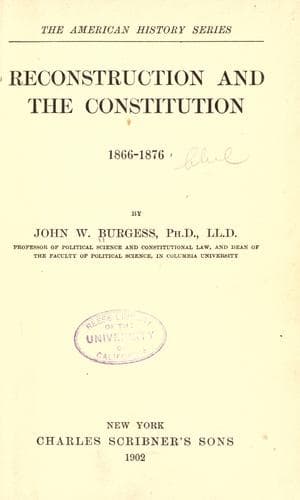
Reconstruction and the Constitution, 1866-1876 — John Shaqi
Reconstruction and the Constitution, 1866-1876Burgess, John William
History
Reconstruction and the Constitution, 1866-1876
Burgess, John William
Reconstruction (U.S. history, 1865-1877); United States -- Politics and government -- 1865-1877
Such being the nature of a "State" of the Union and such the method of
its creation, what reason is there for speaking of the "States" in a
system of federal government as indestructible? As they emerge from the
status of Territories under the exclusive power of Congress, upon
having attained certain conditions, why may they not revert to the
status of Territories upon having lost these conditions of "State"
existence; nay, why may {4} they not revert to the status of martial
law by having lost all of the conditions of civil government? The
dictum "once a State always a State" in a system of federal government
has no sound reason in it. Under the Constitution of the United States,
every "State" of the Union may through the process of amendment be made
a province subject to the exclusive government of the central
authorities; and when those who wield the powers of a "State" renounce
the "State's" allegiance to the United States, renounce the supremacy
of the Constitution of the United States and of the laws of the central
Government made in accordance therewith, then from the point of view of
political science it will become a state pure and simple, a
sovereignty, if and when it permanently maintains, by its own power or
by the assent of the United States, this attitude against the United
States, but from the point of view of the constitutional law of the
United States it simply destroys one of the fundamental conditions of
local self-government, and gives, thus, warrant to the central
Government to resume exclusive government in the district, and over the
population which has become disorganized by refusing obedience to the
supreme law of the land, as fixed by the Constitution of the United
States. Whether the central Government has the physical power, at a
given moment, to do this or not, is another question. It certainly has,
at the outset, the legal right. The "State" is no longer a "State" of
the Union, nor has it become a state out of the Union. It is simply
nowhere. The land is there and the people are there, but the form of
local government over it and them has been changed from local
_self_-government to a Congressional or a Presidential agency, as the
case may be.
[Sidenote: The idea of "State" perdurance.]
[Sidenote: The acceptance of this idea by the Government of the United
States.]
Public-domain text, read in full here on John Shaqi.
Reviews
Reviews
No reviews yet
Be the first to share your thoughts on this work.
Join the Discussion
Join the discussion
Sign in to leave a comment or review.
Sign InorCreate an account