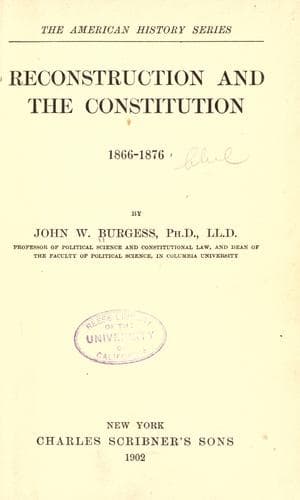
Reconstruction and the Constitution, 1866-1876Burgess, John William
History
Reconstruction and the Constitution, 1866-1876
Burgess, John William
Reconstruction (U.S. history, 1865-1877); United States -- Politics and government -- 1865-1877
Neither is there any reason for holding that the old {5} "State"
organization perdures as an abstract something under the forms of
Congressional or Presidential rule, and will emerge of itself when
these are withdrawn. If the "State" form of local government should be
established again over that same district and over the population
inhabiting it, it would be an entirely new creation, even though it
should recognize the forms and laws and obligations of the old "State."
It must be, however, remembered that both the executive and judicial
departments of the United States Government committed themselves fully
to this theory of "State" perdurance as an abstract something
unaffected by the loss of the conditions of the "State" form of local
government through the rebellion of the "State" organization against
the supremacy of the Constitution and laws of the United States, and
that Congress did the same thing, at first, in some degree. It was this
error which caused all of the confusion in the ideas and processes of
Reconstruction, and we ought, therefore, to rid ourselves of it at the
start, at the same time that we recognize its influence over the minds
of those who engaged in the difficult work of the years between 1865
and 1876.
[Sidenote: The constitutional results of attempted secession.]
From the view which we take of the nature of a "State" in a system of
federal government, and its possible destructibility, there is not much
difficulty in determining the constitutional results of an attempt upon
the part of such a "State" to break away from its connections in that
system. What it does, stripped of all misconception and verbiage, is
simply this: it forcibly resists the execution of the whole supreme law
of the land, and destroys the prime condition of its own existence by
making it necessary for the central Government to {6} assert exclusive
power in the district where this happens. Naturally the executive
department of the central Government must act first, and subdue by
force the force which has been offered against the supremacy of the
Constitution and laws of the United States. After that shall have been
accomplished, the question as to how the population in the rebellious
district shall be civilly organized anew, is one for the legislative
department of the central Government exclusively. Congress may fashion
the boundaries of the district at its own pleasure, and may establish
therein such a Territorial organization of civil local government as it
may see fit, and is limited in what it may do in this respect only by
the constitutional immunities of the individual subject or citizen
under every form of civil government provided or allowed by the
Constitution of the United States. Congress may also enable the
existing population of such a district, or such part of that population
as it may designate, to organize the "State" form of local government,
and may grant it participation in the powers of the central Government
Public-domain text, read in full here on John Shaqi.
Reviews
Reviews
No reviews yet
Be the first to share your thoughts on this work.
Join the Discussion
Join the discussion
Sign in to leave a comment or review.
Sign InorCreate an account