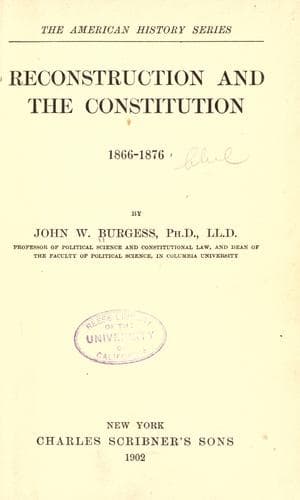
Reconstruction and the Constitution, 1866-1876 — John Shaqi
Reconstruction and the Constitution, 1866-1876Burgess, John William
History
Reconstruction and the Constitution, 1866-1876
Burgess, John William
Reconstruction (U.S. history, 1865-1877); United States -- Politics and government -- 1865-1877
The penalties were somewhat grave. They might be as severe as a fine of
one thousand dollars, or imprisonment for a year, or both, in the
discretion of the courts. But they were not cruel or unusual, and were,
therefore, within the power of Congress to prescribe. The officers
authorized and required to institute proceedings against violators of
the law were the district attorneys, marshals and deputy marshals of
the United States courts, the commissioners appointed by the Circuit
and Territorial courts of the United States, the officers and agents of
the Freedmen's Bureau, and every other officer whom the President might
see fit to empower thereto. And the jurisdiction established for the
trial of such cases was that of the United States courts, upon which
was conferred original and exclusive jurisdiction in any case under the
law, and to which any case touching these subjects commenced in a
"State" court could {70} be removed on motion of the defendant. But all
these things were authorized by a liberal construction of the
Thirteenth Amendment, which expressly vests in Congress the power to
make all laws necessary and proper to enforce the prohibition of
slavery throughout the whole country.
[Sidenote: The measure sound from the points of view of modern
jurisprudence and modern political science.]
It was, indeed, a great change in the system of the jurisprudence of
the United States that the central Government should define and protect
civil equality within the States. But it was a change which history had
forced upon the country, and the sovereign power of the nation had
deliberately legalized it. There is no question now that it was sound
political science, too, and that it was required by public morality.
Real civil liberty is always national. Its concepts and principles
spring out of the national consciousness of rights and wrongs. And
civil equality is the first principle of modern justice, the most
pressing behest of the public morality of the age. Moreover, this
measure did not militate against the President's plan of
Reconstruction. He could have accepted it without compromising that
plan in the slightest, and it was a monumental blunder on his part that
he did not do so.
[Sidenote: The veto of the bill.]
Public-domain text, read in full here on John Shaqi.
Reviews
Reviews
No reviews yet
Be the first to share your thoughts on this work.
Join the Discussion
Join the discussion
Sign in to leave a comment or review.
Sign InorCreate an account