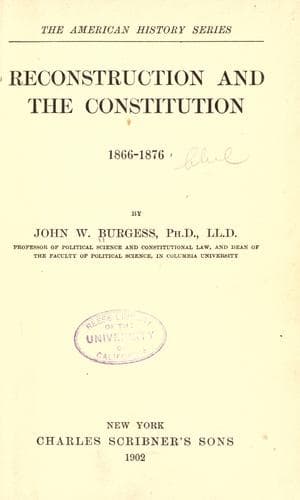
Reconstruction and the Constitution, 1866-1876Burgess, John William
History
Reconstruction and the Constitution, 1866-1876
Burgess, John William
Reconstruction (U.S. history, 1865-1877); United States -- Politics and government -- 1865-1877
On the 27th of March, he sent his veto of the bill into the Senate. It
was a weak argument throughout. He objected to making the freedmen
citizens by an act of Congress, while eleven of the thirty-six "States"
were unrepresented in Congress, and made out that it was a
discrimination in favor of the ignorant negro against the intelligent
foreigner not yet naturalized. He objected to the extension of the
powers of the central Government in behalf of civil equality within the
"States" as destructive of the federal system of government, and as
degrading to the {71} legislators and officials of the "States." He did
not deny that the proposed measure might be sustained as constitutional
under the Thirteenth Amendment, but maintained that it was unnecessary
for the execution of the provisions of the Amendment. He objected,
further, to the number of officers and agents authorized to institute
proceedings under the measure, to the fee which they should receive,
and to the power of the President to order the courts of the United
States to migrate from one place to another when necessary for the
prompt administration of justice. And he objected, finally, to the
power vested in the President to use the land and naval forces and the
militia to prevent the violation, and enforce the due execution, of the
measure.
Now all this was easily answered from the point of view which Congress
and the North had now firmly taken, viz.: that the eleven former
"States" in which rebellion had for so long prevailed were not
"States," although the territory formerly occupied by them, and the
population formerly inhabiting them, were within the United States and
were subject to the jurisdiction of the central Government; that the
rebellion had demonstrated that the central Government must be
intrusted with a large increase of powers in protecting civil equality
and civil liberty; and that the sovereign Nation had willed this in the
enactment and adoption of the Thirteenth Amendment to the Constitution.
[Sidenote: Criticism of the bill.]
Public-domain text, read in full here on John Shaqi.
Reviews
Reviews
No reviews yet
Be the first to share your thoughts on this work.
Join the Discussion
Join the discussion
Sign in to leave a comment or review.
Sign InorCreate an account