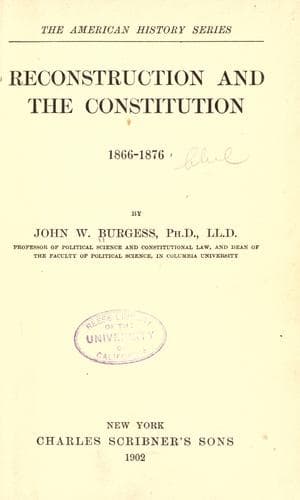
Reconstruction and the Constitution, 1866-1876Burgess, John William
History
Reconstruction and the Constitution, 1866-1876
Burgess, John William
Reconstruction (U.S. history, 1865-1877); United States -- Politics and government -- 1865-1877
upon an equality with the other "States" in the federal system. These
things are matters in which the President, as the executive power,
cannot interfere. As participant in legislation, however, he may, at
his own discretion, use his powers of recommendation and veto.
If rebellion against the supremacy of the Constitution and laws of the
United States should not be committed by an existing "State"
organization, but by a new organization claiming to be the "State"
organization within the district concerned, the existing organization
remaining loyal, but requiring the aid of the central Government to
maintain its authority, then the withdrawal of that aid by the
President after the accomplishment of its purpose would, of course,
leave the old {7} "State" organization with restored authority, and
Congress would have no function to perform in the re-establishment of
civil government in such a district, or in the readmission of its
population to participation in the central Government. This was the
course followed in Missouri and Kentucky, and it was the course, which,
at first, was attempted in the case of Virginia. In the first two cases
it was entirely correct. In the last it had to be abandoned, for
reasons, and on account of conditions, which will be explained later.
What we have, therefore, in the theory and history of Reconstruction is
the case of existing "State" organizations forcibly resisting the
execution of the supreme law of the land, and stricken down by the
executive power of the central Government in the attempt, that power
being exercised at its own motion and in its own way.
{8}
CHAPTER II
PRESIDENT LINCOLN'S VIEWS AND ACTS IN REGARD TO RECONSTRUCTION
Public-domain text, read in full here on John Shaqi.
Reviews
Reviews
No reviews yet
Be the first to share your thoughts on this work.
Join the Discussion
Join the discussion
Sign in to leave a comment or review.
Sign InorCreate an account