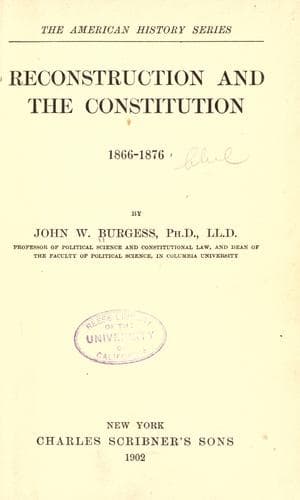
Reconstruction and the Constitution, 1866-1876Burgess, John William
History
Reconstruction and the Constitution, 1866-1876
Burgess, John William
Reconstruction (U.S. history, 1865-1877); United States -- Politics and government -- 1865-1877
There is no doubt that all this, while reflecting the good moral
feeling of Mr. Blaine, was bad political science and was the very
contradictory of sound constitutional law. As has been pointed out
several times already, it would have been good constitutional law had
the United States Congress simply delayed the admission or readmission
{116} of these communities as "States" of the Union until after the
proposed Fourteenth Amendment, and any other desirable amendment,
should have been framed and adopted. Their admission then would have
been into the _same_ Union with all the other States. But to demand of
them, as the condition of admission, their acceptance of things not yet
in the Constitution of the United States, things not obligatory on the
"States" already in the Union, was tantamount to the creation of a new
sort of union with another kind of constitution by an Act of Congress.
This question had been thoroughly talked out, fought out, and decided
in 1820, and for nearly fifty years it had been the settled principle
of constitutional law that Congress has no such power. It has been also
pointed out that a sound political science of the federal system of
government teaches the same principle.
[Sidenote: Mr. Stevens's refusal to accept Mr. Blaine's amendment.]
[Sidenote: Passage of the bill by the House.]
Mr. Stevens acted correctly, from the point of view of political
science and constitutional interpretation, when he declined to accept
Mr. Blaine's amendment, or to allow a vote to be taken on it, and the
House of Representatives also acted correctly from the same point of
view when it voted down a proposition from Mr. Blaine to send his
amendment along with the bill to the Judiciary Committee of the House
with instruction to report it back with the bill. But it is not to be
inferred from the debates that either Mr. Stevens or the House was
actuated in this course of conduct by the above mentioned
considerations. The expansion of the powers of government inevitably
consequent upon a long period of war seemed to have made them all very
nearly forget that there was anything but government in our political
system. The chief thought was that one Congress could not bind another
with any such promises as those held {117} out in the Blaine amendment,
and that each Congress must at all times be left to its own discretion
in the determination of every question. The House passed the bill as it
came from the Committee on Reconstruction without change or amendment,
and on the 13th of February it appeared in the Senate.
[Sidenote: The bill in the Senate.]
This more conservative and deliberate body regarded the bill as too
radical, and after considerable debate upon a proposed amendment,
offered first by Senator Williams of Oregon, and then by Senator
Reverdy Johnson, which was in substance the Blaine proposition, laid it
aside by general consent and allowed Senator Sherman to offer a
substitute for it.
[Sidenote: The Sherman substitute.]
Public-domain text, read in full here on John Shaqi.
Reviews
Reviews
No reviews yet
Be the first to share your thoughts on this work.
Elsewhere in the archive
Join the Discussion
Join the discussion
Sign in to leave a comment or review.
Sign InorCreate an account