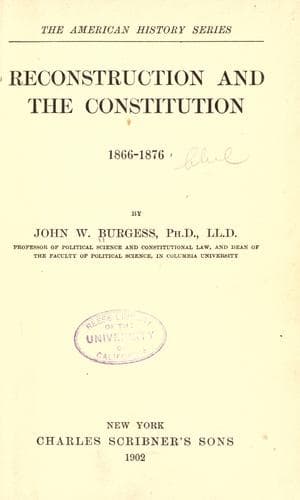
Reconstruction and the Constitution, 1866-1876Burgess, John William
History
Reconstruction and the Constitution, 1866-1876
Burgess, John William
Reconstruction (U.S. history, 1865-1877); United States -- Politics and government -- 1865-1877
This substitute contained the gist of the Blaine amendment, and also
changed the provision which proposed to deprive the President of his
constitutional prerogative of commandership-in-chief of the army. While
the bill was thus made a less brutal measure, and in one respect a less
unconstitutional measure, it still rested upon a very shaky foundation
so far as constitutional law was concerned, and it was opposed by all
the Democratic Senators. It was passed, however, by a large majority,
every Republican who voted voting in favor of it.
[Sidenote: The substitute in the House.]
[Sidenote: The Senate substitute rejected by the House.]
[Sidenote: The bill as finally agreed upon.]
When it was returned to the House of Representatives for concurrence,
the Radical Republicans developed a most hostile opposition to the
changes which had been made by the Senate. They claimed that the Senate
bill proposed to bind future Congresses by pledges which the existing
Congress had no right to make and no power to execute, and that it also
proposed to use the rebel element of the population of the South in the
work of reconstructing loyal "State" {118} governments. After a long
and acrid debate, the House rejected the Senate's substitute by a union
of Democratic votes with the votes of the Radical Republicans. This
result and the manner of its attainment so frightened the Republicans,
however, that they quickly came to an understanding among themselves in
the House, and with their party colleagues in the Senate, and passed
the Senate's substitute, so amended as to prevent disloyal men, as
designated in the proposed Fourteenth Amendment, from voting for
delegates to a reconstruction convention, or being delegates therein,
or being officers in any so-called "State" government before the
admission of the Senators and Representatives from that "State" into
Congress, and so amended further as to pronounce all professed civil
governments existing in any of the late so-called Confederate States,
except of course Tennessee, provisional only, until Senators and
Representatives from the same should be admitted to seats in Congress,
and subject, as provisional governments, to the paramount authority of
the United States which should control them, and might supersede or
abolish them at any time. The Senate also accepted these amendments,
and on the 20th of February the bill was placed in the hands of the
President.
[Sidenote: The contents of the bill as passed.]
Public-domain text, read in full here on John Shaqi.
Reviews
Reviews
No reviews yet
Be the first to share your thoughts on this work.
Elsewhere in the archive
Join the Discussion
Join the discussion
Sign in to leave a comment or review.
Sign InorCreate an account