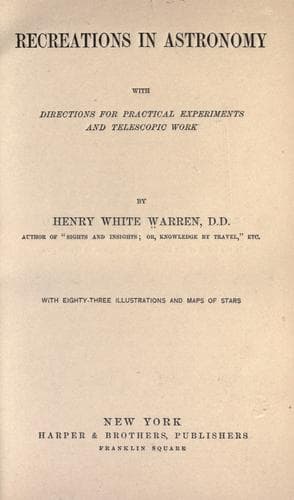
Recreations in Astronomy: With Directions for Practical Experiments and Telescopic WorkWarren, Henry White
Religion
Recreations in Astronomy: With Directions for Practical Experiments and Telescopic Work
Warren, Henry White
Astronomy
This power is also fit and able to survive. The engineer Stephenson
once asked Dr. Buckland, "What is the power that drives that train?"
pointing to one thundering by. "Well, I suppose it is one of your
big engines." "But what drives the engine?" "Oh, very likely a canny
Newcastle driver." "No, sir," said the engineer, "it is sunshine."
The doctor was too dull to take it in. Let us see if we can trace
such an evident effect to that distant cause. Ages ago the warm
sunshine, falling on the scarcely lifted hills of Pennsylvania,
caused the reedy vegetation to grow along the banks of [Page 31]
shallow seas, accumulated vast amounts of this vegetation, sunk it
beneath the sea, roofed it over with sand, compacted the sand into
rock, and changed this vegetable matter--the products of the
sunshine--into coal; and when it was ready, lifted it once more, all
garnered for the use of men, roofed over with mighty mountains. We
mine the coal, bring out the heat, raise the steam, drive the train,
so that in the ultimate analyses it is sunshine that drives the
train. These great beds of coal are nothing but condensed
sunshine--the sun's great force, through ages gone, preserved for
our use to-day. And it is so full of force that a piece of coal that
will weigh three pounds (as big as a large pair of fists) has as
much power in it as the average man puts into a day's work. Three
tons of coal will pump as much water or shovel as much sand as the
average man will pump or shovel in a lifetime; so that if a man
proposes to do nothing but work with his muscles, he had better dig
three tons of coal and set that to do his work and then die, because
his work will be better done, and without any cost for the
maintenance of the doer.
Come down below the color vibrations, and we shall find that those
which are too infrequent to be visible, manifest as heat. Naturally
there will be as many different kinds of heat as tints of color,
because there is as great a range of numbers of vibration. It is
our privilege to sift them apart and sort them over, and find what
kinds are best adapted to our various uses.
Public-domain text, read in full here on John Shaqi.
Reviews
Reviews
No reviews yet
Be the first to share your thoughts on this work.
Join the Discussion
Join the discussion
Sign in to leave a comment or review.
Sign InorCreate an account