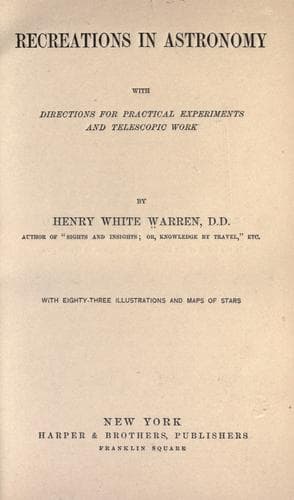
Recreations in Astronomy: With Directions for Practical Experiments and Telescopic Work — John Shaqi
Recreations in Astronomy: With Directions for Practical Experiments and Telescopic WorkWarren, Henry White
Religion
Recreations in Astronomy: With Directions for Practical Experiments and Telescopic Work
Warren, Henry White
Astronomy
Take an electric lamp, giving a strong beam of light and heat, and
with a plano-convex lens gather it into a single beam and direct
it upon a thermometer, twenty feet away, that is made of glass
and filled with air. The [Page 32] expansion or contraction of this
air will indicate the varying amounts of heat. Watch your
air-thermometer, on which the beam of heat is pouring, for the
result. There is none. And yet there is a strong current of heat
there. Put another kind of test of heat beyond it and it appears;
coat the air-thermometer with a bit of black cloth, and that will
absorb heat and reveal it. But why not at first? Because the glass
lens stops all the heat that can affect glass. The twenty feet of
air absorbs all the heat that affects air, and no kind of heat is
left to affect an instrument made of glass and air; but there are
kinds of heat enough to affect instruments made of other things.
A very strong current of heat may be sent right through the heart
of a block of ice without melting the ice at all or cooling off
the heat in the least. It is done in this way: Send the beam of
heat through water in a glass trough, and this absorbs all the heat
that can affect water or ice, getting itself hot, and leaving all
other kinds of heat to go through the ice beyond; and appropriate
tests show that as much heat comes out on the other side as goes
in on this side, and it does not melt the ice at all. Gunpowder
may be exploded by heat sent through ice. Dr. Kane, years ago,
made this experiment. He was coming down from the north, and fell
in with some Esquimaux, whom he was anxious to conciliate. He said
to the old wizard of the tribe, "I am a wizard; I can bring the
sun down out of the heavens with a piece of ice." That was a good,
deal to say in a country where there was so little sun. "So," he
writes, "I took my hatchet, chipped a small piece of ice into the
form of a double-convex lens, [Page 33] smoothed it with my warm
hands, held it up to the sun, and, as the old man was blind, I
kindly burned a blister on the back of his hand to show him I could
do it."
These are simple illustrations of the various kinds of heat. The
best furnace or stove ever invented consumes fifteen times as much
fuel to produce a given amount of heat as the furnace in our bodies
consumes to produce a similar amount. We lay in our supplies of
carbon at the breakfast, dinner, and supper table, and keep ourselves
warm by economically burning it with the oxygen we breathe.
Heat associated with light has very different qualities from that
which is not. Sunlight melts ice in the middle, bottom, and top at
once. Ice in the spring-time is honey-combed throughout. A piece
of ice set in the summer sunshine crumbles into separate crystals.
Dark heat only melts the surface.
Public-domain text, read in full here on John Shaqi.
Reviews
Reviews
No reviews yet
Be the first to share your thoughts on this work.
Join the Discussion
Join the discussion
Sign in to leave a comment or review.
Sign InorCreate an account