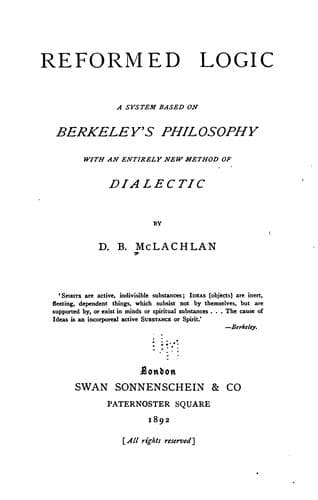
Reformed Logic: A System Based on Berkeley's Philosophy with an Entirely New Method of Dialectic — John Shaqi
Reformed Logic: A System Based on Berkeley's Philosophy with an Entirely New Method of DialecticMcLachlan, D. B.
Philosophy
Reformed Logic: A System Based on Berkeley's Philosophy with an Entirely New Method of Dialectic
McLachlan, D. B.
Logic
Men pretend to act from reason only, and perhaps they do on matters to
which they are indifferent. But in general their rationality consists
in finding pretexts for what on sentimental grounds they have already
resolved to do, and in finding ways and means to carry out their
resolves. Sentiment is the moving spring of conduct: intellect is
the executive faculty. Those historical philosophers are mistaken who
suppose the progress of mankind results from intellectual discoveries
and inventions. These are effects, not causes, of progress--effects of
_sentimental_ disagreement with previous conditions.
Intellect is little more than an extension inwards of our senses.
It is an epitome and rearrangement of their observations, and is as
instrumental as they. We are not necessarily improved by a development
of the intellect forced upon us from without. Education is sometimes
a dagger put into the hands of an assassin. The best education is
largely sentimental (moral), for that is not confined to preserving
the mind we have--it gives us another and a better mind, and so
indirectly improves the intellect.
V--TRUTH
This word has several meanings which it may be well to notice.
As _veracity_ it means an agreement between our thoughts and our
language. It supposes that we take reasonable pains to learn the
conventional laws upon which language is founded, and then endeavour
as far as possible to bring our speech in conformity with these laws.
Since language is an art (like music) it may be acquired well or ill,
so that a mistake in the use of a phrase or term is not regarded as
untruth. There must be deliberate abuse of language to constitute a
lie.
Agreement between an idea of memory and the actual experience--correct
recollection--is another meaning of truth.
Also truth may signify agreement between an inferential thought
and the fact to which it refers, although the fact has not yet been
observed. In this sense truth must be construed liberally. We never
foresee a future fact exactly as it will take place. Our anticipations
are vague and our preparations for them general, but that on the whole
is enough for our purposes. At least it is all that reason affords us.
If we are absolutely certain of a future fact and can figure it in the
mind precisely as it will take place, that means that it has already
occurred so often that we are virtually using our memory, not our
reason.
An inference may be considered true if it is the best we can draw from
the information at our command, though in point of fact it may prove
to be very incorrect.
Public-domain text, read in full here on John Shaqi.
Reviews
Reviews
No reviews yet
Be the first to share your thoughts on this work.
Join the Discussion
Join the discussion
Sign in to leave a comment or review.
Sign InorCreate an account