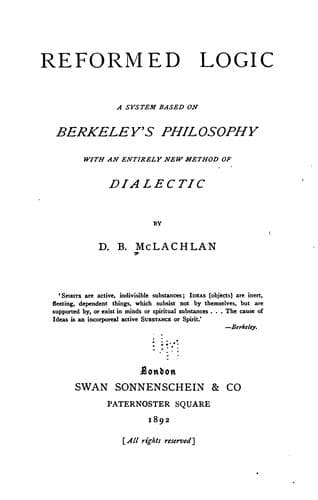
Reformed Logic: A System Based on Berkeley's Philosophy with an Entirely New Method of Dialectic — John Shaqi
Reformed Logic: A System Based on Berkeley's Philosophy with an Entirely New Method of DialecticMcLachlan, D. B.
Philosophy
Reformed Logic: A System Based on Berkeley's Philosophy with an Entirely New Method of Dialectic
McLachlan, D. B.
Logic
There is no mass of speculative Truth which everybody ought to
possess on pain of being considered foolish or miscreant. This notion,
formerly so prevalent, betrays gross ignorance of the nature and
function of intellect. It makes intellectual speculation an end in
itself. Our ideas must be such as serve the uses of our sentimental or
inner soul, and since the sentiments (tastes) of men vary widely,
so ought also their intellectual ideas. Though change of sentiment
modifies ideas, change of ideas does not modify sentiment. There is
therefore no sort of good in uniformity of belief in itself. It is
creditable to modern times that men have shaken off the procrustean
beliefs of the Middle Ages, and are free to adapt their intellects
to their real sentimental needs. The numerous sections into which
speculative thought is now broken up, and the frequent changes of
theory, are signs of healthy and active sentiment.
In matters of social policy, where large bodies of men have to carry
out a single design, uniformity must be attained by persuasion or
compromise. But such matters relate only to physical well-being, into
which philosophical truth can hardly be said to enter.
This relative and, in the widest sense, utilitarian view of
intellectual truth applies both to quantity and quality of ideas. We
should not learn what we do not sentimentally require. That is waste
of power. Useless knowledge is folly, said both Plato and Aristotle.
To mistake knowledge to be the pursuit of man is to confuse the means
with the end, says the author of the Bhagavad Gita.
The quality of our ideas must not be good beyond our necessities.
If they are, we shall suffer by acting on them. They will land us in
circumstances for which our nature is not fully prepared.
If there were an abstract or standard truth, it would be good for
every species of being, and no doubt the thoughts of a man are nearer
to it than the thoughts of a horse. Therefore a horse ought to be
improved by receiving a human intellect. But if we could insinuate
into a horse's mind the knowledge possessed by an educated man, we
should spoil what may have been a good horse and produce a monstrous
and horrible man. So is it with ourselves. If we could receive
knowledge far in advance of our requirements or out of relation to
them, it would drive us mad or be itself madness. Our constitution and
necessities determine what we can know and what we ought to know.
Not all possible knowledge is good, and what is good for some may be
useless or bad for others. Schopenhauer says well[3]: 'The faculty of
Knowing ... has only arisen for the purpose of self-preservation,
and therefore stands in a precise relation, admitting of countless
gradations, to the requirements of each animal species.'
VI--REALISM
Public-domain text, read in full here on John Shaqi.
Reviews
Reviews
No reviews yet
Be the first to share your thoughts on this work.
Join the Discussion
Join the discussion
Sign in to leave a comment or review.
Sign InorCreate an account