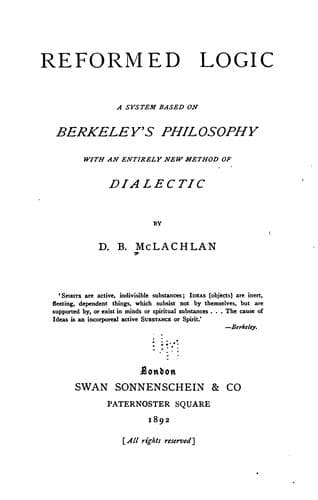
Reformed Logic: A System Based on Berkeley's Philosophy with an Entirely New Method of DialecticMcLachlan, D. B.
Philosophy
Reformed Logic: A System Based on Berkeley's Philosophy with an Entirely New Method of Dialectic
McLachlan, D. B.
Logic
It is not from without but from within that doubts arise as to
realistic truth. They arise when the mind has acquired power over and
above what is needed for bodily uses, and begins to think on its own
account. Sentiments are felt which do not depend on or refer to bodily
life, and a new intellect has to be formed to explain and protect
these sentiments. This new intellect is Philosophy. It is the science
and practical conduct of mind considered as abstracted from body.
Much of the obscurity of philosophy is traceable to the superstition
of a fixed standard of truth which must be recognised universally.
We are reluctant to accept philosophical hints and inferences
because they conflict with truths that have been physically verified.
Or--which is more common--we take up a few philosophical propositions
and tack on to them all the science we know, believing they make a
homogeneous whole, because truth must be self-consistent.
Time and labour would be spared if we could be told at the right
moment that truth is expedience[4], and that there is no need to
harmonise philosophy and science. We are each of us two men in one,
and each of these men must be allowed to think for himself. There is
no reason why they should quarrel; there is no reason why they should
even argue. The science in our mind should not be ousted to make room
for the philosophy; let them exist together and work alternately. When
the mariner is at sea he must mind his ship and study the weather;
when he is on shore he may neglect both. So when we are navigating
the body we have to think in categories proper to its safety; as
philosophers we dismiss the realistic categories and think in other
forms, but we need not then call the realism false or foolish. In its
proper place it is right and true[5].
Between realism and substantialism there is therefore no necessary
conflict or competition. They are each indispensable. It is absurd
to carry realism into philosophy, and no less absurd to carry
substantialism into common affairs, or to reproach a substantialist
because he acts and speaks occasionally like other people. It
is probable however that in a community largely composed of
substantialists the realism of common action would be less stringent
than is now found necessary.
[Footnote 3: _Will in Nature_, 'Physiology of Plants.']
[Footnote 4: This does not apply to truth in the sense of
veracity.]
Public-domain text, read in full here on John Shaqi.
Reviews
Reviews
No reviews yet
Be the first to share your thoughts on this work.
Join the Discussion
Join the discussion
Sign in to leave a comment or review.
Sign InorCreate an account