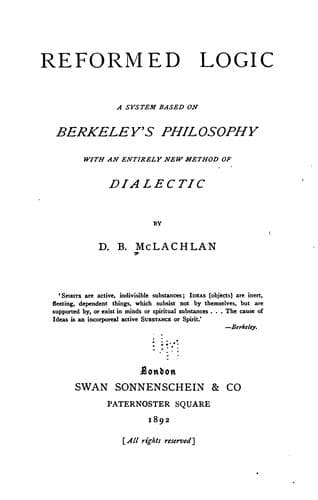
Reformed Logic: A System Based on Berkeley's Philosophy with an Entirely New Method of DialecticMcLachlan, D. B.
Philosophy
Reformed Logic: A System Based on Berkeley's Philosophy with an Entirely New Method of Dialectic
McLachlan, D. B.
Logic
[Footnote 5: Greek philosophers never understood the dual
standard of Truth, and insisted that philosophy was the best
preparation for every sort of employment. The people, though
generally unwise in political matters, had sense enough not to
entrust the care of their temporal interests to philosophers,
and so the universal utility of philosophy had few
opportunities of being tested. A Macedonian king committed the
custody of Corinth and its citadel to a philosopher, Persaeus,
who was promptly expelled by Aratus--a mere soldier. Persaeus
frequented the schools again, and on the well-worn theme that
'none but a wise man is fit to be a general' being brought up
for discussion, he said, 'It is true, and the gods know it,
that this maxim of Zeno once pleased me more than all the
rest; but I have changed my opinion since I was taught better
by the young Sicyonian.'--Plutarch's _Life of Aratus_.]
PERCEPTION
VII
Perception has already been partially defined. So-called 'external
objects' are forms excited in our consciousness by pressure of other
minds. The great permanent 'world' is due to the action of a cosmic
mind with which we are intimately associated throughout our physical
life.
Objects have a totally different sort of existence from minds, for
whereas the latter are--at least relative to objects--self-existent,
the former have no existence except during the act of perception. If
minds could be all moved asunder from each other the whole objective
world would disappear, yet the universe would be as full as before,
for sensation occupies no room.
The appearances we interpret as distance are due to variations in the
pressure or stimulus producing the object.
It will be convenient to call the more active mind _Noumenon_, the
perceiving mind _Subject_. The mind that is subject on one occasion
may be noumenon at another, and conversely. The true antithesis to
subject is not object, but noumenon. Object has no antithesis, unless
it be nonentity.
It is specially to be noticed that an object is not the _cause_ of a
sentiment. The knife we see or handle is not the cause of the pain it
may inflict if driven into our flesh. Pains and pleasures signify that
the noumenal action is powerful enough not only to excite objects in
the intellect, but to penetrate inwards and excite sentiments also. It
is the noumenon that causes both object and sentiment, as far as
the energy exerted is concerned, but the variation of plasma in the
subject is also essential to the distinction of object and sentiment.
Public-domain text, read in full here on John Shaqi.
Reviews
Reviews
No reviews yet
Be the first to share your thoughts on this work.
Join the Discussion
Join the discussion
Sign in to leave a comment or review.
Sign InorCreate an account