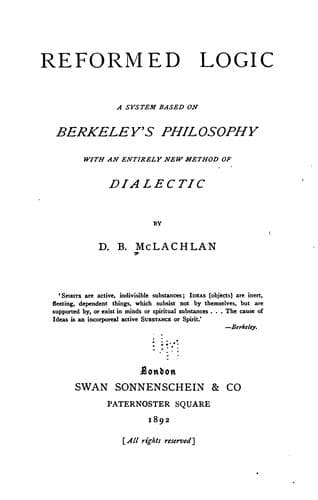
Reformed Logic: A System Based on Berkeley's Philosophy with an Entirely New Method of DialecticMcLachlan, D. B.
Philosophy
Reformed Logic: A System Based on Berkeley's Philosophy with an Entirely New Method of Dialectic
McLachlan, D. B.
Logic
Philosophy is not an advance or correction of science. In so far
as the latter claims to be absolutely or philosophically true,
substantialism abolishes it in dispensing with the notions of real
matter and real space. Hence it is quite irrelevant to point out that
substantialism is inconsistent with (say) the doctrine of physical
evolution. This theory, though so new, is now often referred to as
axiomatically true, whereas it is an inference, the evidence for
which, even to many realists, is far from conclusive. Whether it be
considered true or not in science, physical evolution is quite untrue
in philosophy.
IDEAS
VIII--HOW PRODUCED
An imprint or mould of the object is generally left in the plasma of
the subject. The imprint is deep, clear and lasting in proportion to
the strength of the exciting cause and the degree of energy assigned
to the perception. When the noumenon withdraws the object does not at
once disappear, for if the energy of attention remain the mould
left by the noumenon serves to excite a consciousness similar to the
object, and this is what we call an IDEA.
What Hume says as to an object differing from an idea in nothing
but vividness is evidently incorrect. Objects are generally, but not
always, more vivid than ideas, and when an object is present we
have an indefeasible conviction of being acted on by something not
ourselves, which conviction is not present in recollection. We may not
be able to give a satisfactory reason for the conviction--if we are
arguing idealistically we certainly shall not--but the fact that it is
there serves to mark off objects as a class of consciousness distinct
from ideas, irrespective of their vividness. If an object were once
seen clearly and so remembered, and were afterwards seen indistinctly
through a mist, the latter consciousness would (according to Hume) be
the idea and the former the object. Such an application of words would
be an abuse of language.
There are of course no innate ideas of _objects_. There is innate
consciousness--the sentimental.
Ideas are of three kinds--Particular Ideas, General Ideas,
Imaginary Ideas--corresponding to the so-called faculties of Memory,
Generalisation or Classification, and Imagination.
IX--MEMORY OF OBJECTS
When the energy of attention is exhausted or withdrawn the idea also
disappears, but it may be revived by bringing the energised Self in
contact with the imprint again, and this operation can be repeated
indefinitely. The power of exciting ideas of past experience is
Memory; any particular exercise of memory is Recollection.
Public-domain text, read in full here on John Shaqi.
Reviews
Reviews
No reviews yet
Be the first to share your thoughts on this work.
Join the Discussion
Join the discussion
Sign in to leave a comment or review.
Sign InorCreate an account