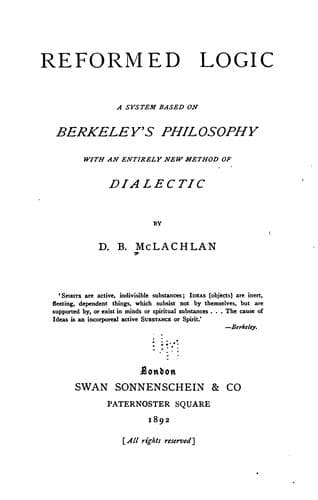
Reformed Logic: A System Based on Berkeley's Philosophy with an Entirely New Method of DialecticMcLachlan, D. B.
Philosophy
Reformed Logic: A System Based on Berkeley's Philosophy with an Entirely New Method of Dialectic
McLachlan, D. B.
Logic
The imprint of an object is not absolutely permanent and is probably
never quite true. It begins to lose sharpness at once, but if the
object be frequently observed and much remembered, it will retain
its general character for years. The exercise of memory, instead of
wearing out the imprint as would be the case with a material negative
or engraved plate, keeps the channels open[6]. Persons of little
experience remember well, for their energy of attention is not
distributed over many different ideas; it travels continuously round
a small circuit. One hears ignorant persons recounting events that
happened years ago, with as much detail and with almost as much
sentiment as if they had taken place the day before. A 'good
memory' is no proof that the quality of mind or thought is good. All
experience is not worth remembering. One of the most difficult things
in moral culture is to get rid of the imprints of ideas that are out
of harmony with our improved sentiment.
Although the imprints in our mind may close up and leave scarce a
cicatrice, the part that has been once disturbed is never the same as
the virgin plasm. It remains a little more tender. It may not reopen
to ordinary stimuli, but an extra agitation of the plasm will rip up
the closed furrows, and give us back scenes in our life that had long
ceased to be recollected. A great agitation in all parts of the mind
may revive what appears to be the whole of our past experience in a
simultaneous recollection. So I explain the extraordinary lucidity
that sometimes occurs in fevers and in moments of extreme terror.
It is also conceivable that the egoistic energy may be so strong as
to destroy outright the moulds of thought, as a flood sweeps away the
banks of a river. 'We sometimes find a disease quite strip the mind
of all its ideas, and the flames of a fever in a few days calcine all
those images to dust and confusion which seemed to be as lasting as if
graved in marble'[7].
What is called 'decay of the mind' in old age is merely the loss of
the plasmic images. Since intellect would not have been formed in the
first instance if it had not been wanted, it is to be expected that it
will fade out of the mind when it is no longer wanted. So far as the
realistic intellect is concerned, we return to 'second childhood' and
the uniform sensibility we had at birth.
No philosophy but the substantial explains memory. Idealists and
metaphysicians, who recognise only consciousness, are utterly unable
to account for the revival of a shadowy sort of objects in the absence
of their original causes. Here is the melancholy confession of John
Stuart Mill on the subject:--
Public-domain text, read in full here on John Shaqi.
Reviews
Reviews
No reviews yet
Be the first to share your thoughts on this work.
Join the Discussion
Join the discussion
Sign in to leave a comment or review.
Sign InorCreate an account