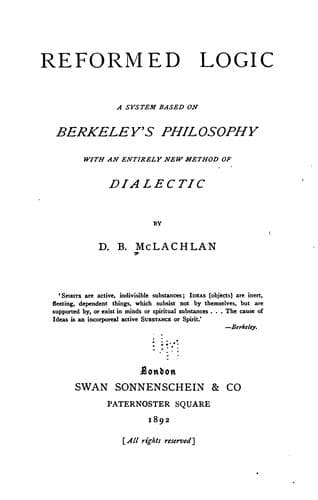
Reformed Logic: A System Based on Berkeley's Philosophy with an Entirely New Method of Dialectic — John Shaqi
Reformed Logic: A System Based on Berkeley's Philosophy with an Entirely New Method of DialecticMcLachlan, D. B.
Philosophy
Reformed Logic: A System Based on Berkeley's Philosophy with an Entirely New Method of Dialectic
McLachlan, D. B.
Logic
In this case we have a quadruple consciousness. There is first
the present object; next the recollection of the object originally
associated with the same imprint; thirdly, a consciousness of
_resemblance_ between the new and the old (the present object and the
recollected idea) in so far as the imprints coincide, and (fourthly)
a sense of _difference_ in so far as they disagree. The limitation
of resemblance gives rise to the sense of difference--a negative
consciousness--and the shock of difference emphasises the resemblance.
This is Comparison, the common basis of Generalisation and
Imagination.
[Footnote 6: As if the image had the form of a stencil.]
[Footnote 7: Locke, _Essay on the Understanding_, ii. x. 5.]
[Footnote 8: _Exam. of Hamilton's Philosophy_, p. 212-3.]
[Footnote 9: I append Spinoza's list, and print in italics the
sentiments that appear to me to be emotions as
distinguished from feelings.
Desire--Pleasure--Pain--Wonder--_Contempt_--_Love_--_Hate_--
_Inclination_--_Aversion_--_Devotion_--Derision--_Hope_--_Fear_--
_Confidence_--_Despair_--Joy--Grief--Pity--Approval--Indignation--
Overesteem--_Disparagement_--_Envy_--Mercy
(or
goodwill)--Self-contentment--Humility--_Repentance_--_Pride_--
Dejection--Honour--_Shame_--_Regret_--_Emulation_--Thankfulness--
Benevolence--Anger--_Revenge_--Cruelty--_Daring_--_Cowardice_--
_Consternation_--_Civility_
(or
deference)--_Ambition_--Luxury--Drunkenness--Avarice--Lust.
Pollock's _Spinoza_, ch. vii.]
GENERALISATION
XII--NATURE AND FUNCTION
General Ideas are formed by the coincident imprint of several objects
in some respects different, but which have all a resemblance as
objects, and are besides the signs of the same sentimental effect.
If the effects are different the confusion of the objects occasions
practical error, as when we mistake one man for another whom he
closely resembles. Though the sentimental utilities should be the
same, the object cannot be reduced to a common idea if they are quite
dissimilar: for example, a sand-glass and a watch have similar uses,
but they cannot be generalized. The value of generalisation to a
thinker is that it economises memory and recollection by making one
common or average idea do duty for many particular ideas. Let us
follow the process in detail.
Public-domain text, read in full here on John Shaqi.
Reviews
Reviews
No reviews yet
Be the first to share your thoughts on this work.
Join the Discussion
Join the discussion
Sign in to leave a comment or review.
Sign InorCreate an account