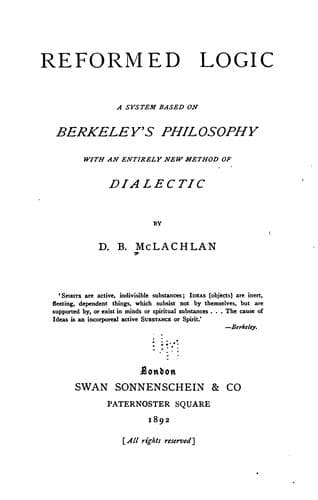
Reformed Logic: A System Based on Berkeley's Philosophy with an Entirely New Method of DialecticMcLachlan, D. B.
Philosophy
Reformed Logic: A System Based on Berkeley's Philosophy with an Entirely New Method of Dialectic
McLachlan, D. B.
Logic
No two moral philosophers give the same list of sentiments. Some
are satisfied with two--pain and pleasure. Spinoza gives a list of
forty-seven[9] sentiments, which includes luxury and drunkenness. It
is evident that luxury is a general term which covers many different
forms of feeling, and if the feeling of intoxication by alcohol is
worth mentioning, so also must be the intoxications by opium and
tobacco; and if these are included we must admit the feeling of
nausea, which brings us to the sentiments associated with all diseased
conditions of body or mind. Such distinctions are superfluous, for if
the sentiment is purely personal and not associated with an external
object, it is not of any general interest; if associated with an
object and common to many persons it is best defined by reference to
the object--as the pleasure of smelling a _rose_.
We have sometimes feelings of elation and depression for which we
cannot find an internal reason nor yet an objective sign. Many of
the so-called religious experiences are of this sort. So also are the
sudden sympathies and aversions we feel towards certain people and
places. Here there is an object, but we cannot find anything in the
object that can be taken as specially significant of the feeling. We
are said not to be able to 'analyse' our feeling, that is, assign it
an object as cause.
These abnormal feelings may be explained by supposing that some
external influences succeed in reaching our sentiment without exciting
our intellect. Considering that intellect is artificial and may be
very imperfect, and also that its efficiency depends to some extent
on its being less sensitive than the original mental nature, it is
reasonable to conclude that subtle emanations from our surroundings
may occasionally affect us without exciting the intellectual
consciousness. Panic, inspiration, mesmerism, and other 'occult'
influences are probably due to this cause. If we further assume that
sentiments so excited may then, by association, excite appropriate
_ideas_ in the intellect of the recipient, we have a likely
explanation of what is called 'thought-transference.' Since ideas
excite emotions, it is reasonable to suppose that feelings may excite
ideas, or even the illusion that objects are being perceived.
XI--COMPARISON
Most ideas, except the particular (which are copies of single
objects), are associated with a consciousness of resemblance and
difference which arises in the following manner.
When new experience simply revives the imprint of a former experience
we call it the _same_ object or objects, though it is not numerically
the same, being different at least in time. If a totally new imprint
is made in the mind the experience is quite novel or _strange_, but we
do not call it different.
Experience is usually neither quite the same as before nor quite
strange, which means that the present noumenon has partially revived
an old imprint and made a partially new one.
Public-domain text, read in full here on John Shaqi.
Reviews
Reviews
No reviews yet
Be the first to share your thoughts on this work.
Join the Discussion
Join the discussion
Sign in to leave a comment or review.
Sign InorCreate an account