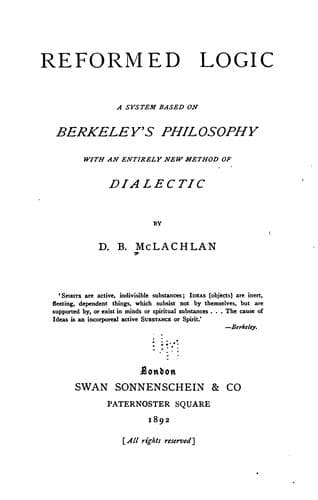
Reformed Logic: A System Based on Berkeley's Philosophy with an Entirely New Method of Dialectic — John Shaqi
Reformed Logic: A System Based on Berkeley's Philosophy with an Entirely New Method of DialecticMcLachlan, D. B.
Philosophy
Reformed Logic: A System Based on Berkeley's Philosophy with an Entirely New Method of Dialectic
McLachlan, D. B.
Logic
For myself I feel no such compulsion. When things are complex I
recollect the several properties as cohering together, and when I
abstract one or some for special consideration, I sometimes think of
the others as forming a 'substance' in which the abstracted properties
inhere. But I cannot discover any inherence or coherence except the
mutual, and the notion of an invisible material setting which
holds all the parts of a thing together seems to me superfluous
and unwarranted. If it existed it would not be, as logicians argue,
something superior and antithetical to phenomena; it would be simply
an inferred or latent phenomenon like the luminiferous ether of
science. The material substance is evidently a groping of the mind
after the noumenal (mental) substance which causes the appearance of
objects.
XIV--NOMINALISM
Nominalists deny the existence of general ideas as distinct from
particular ideas. Most of them affirm that we employ general or common
words to signify the common properties of similar things, but that we
are incapable of thinking of these common properties apart from the
other properties that accompany them.
Why we should wish to use signs of things we cannot think about,
or how a word can be a 'sign' when we are incapable of attaching a
definite meaning to it, are points not satisfactorily cleared up by
nominalists.
Considering how well Berkeley's principle, combined with the plasmic
theory, accounts for generalisation, and how inevitable it is that
there should be general ideas distinguishable from particular ideas
by superior brilliancy and endurance, it is surprising to find in
Berkeley one of the most convinced and eloquent of nominalists. His
views on the subject have so much weight with philosophers that I must
examine them at length.
'It is agreed on all hands,' he writes in the Introduction to
his _Principles_, 'that the qualities or modes of things do
never really exist each of them apart by itself, and separated
from all others, but are mixed, as it were, and blended
together, several in the same object. But, we are told, the
mind being able to consider each quality singly, or abstracted
from those other qualities with which it is united, does by
that means frame to itself abstract ideas. For example, there
is perceived by sight an object extended, coloured, and moved:
this mixed or compound idea the mind resolving into its simple
constituent parts, and viewing each by itself, exclusive of
the rest, does frame the abstract ideas of extension, colour,
and motion. Not that it is possible for colour or motion to
exist without extension; but only that the mind can frame
to itself by _abstraction_ the idea of colour exclusive
of extension, and of motion exclusive of both colour and
extension.'
Public-domain text, read in full here on John Shaqi.
Reviews
Reviews
No reviews yet
Be the first to share your thoughts on this work.
Join the Discussion
Join the discussion
Sign in to leave a comment or review.
Sign InorCreate an account