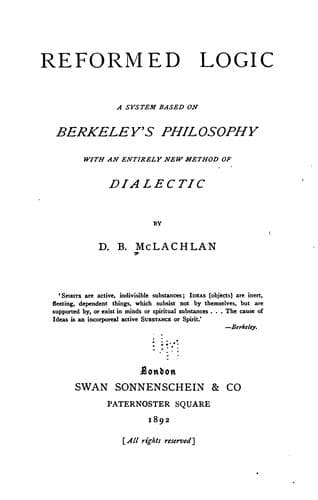
Reformed Logic: A System Based on Berkeley's Philosophy with an Entirely New Method of DialecticMcLachlan, D. B.
Philosophy
Reformed Logic: A System Based on Berkeley's Philosophy with an Entirely New Method of Dialectic
McLachlan, D. B.
Logic
There exists nothing but living minds of different degrees of energy.
We men are small beings associated with a cosmical creature whose
force is immeasurably greater than ours, and we have intelligence
enough to utilise part of this force to supplement our own. That is
the meaning of _mechanism_. Some efforts to control the cosmic forces
are profitable, but there is no transmutation of our energy into
the result, nor any necessary equivalence between the labour and
the result. We may stumble upon an available cosmic force almost by
accident--we may waste a life-time over a mechanical problem and fail
to solve it.
The utilisation of cosmic force by man is best explained by comparing
it with animal slavery. Trap a wild elephant and train him to draw and
carry--you have constructed an engine. There are of course important
differences between the two kinds of instrument, due to the enormous
disproportion between the magnitude and power of the respective
entities. In the case of the animal the whole life comes under our
control: in the case of the cosmos we can utilise only a minute
fraction of it, and that rather by putting ourselves in its way than
by making it obey us. The animal we have to feed: the cosmic being
does not draw upon us for its nourishment. We can direct the animal
through his sensibility: the cosmic sensibility appears to be beyond
our power of irritation.
Apart from these differences the general laws of the one kind of tool
are those of the other also. We have not transferred power to the
raised stone, or the coiled spring, or the loaded gun, or the embanked
river--any more than to the tamed and harnessed horse. There is no
fixed ratio between the fatigue of catching and training an animal,
and the energy saved by making him work for us. The animal's work
is not our own energy given back to us--neither is the machine's. A
plough is useless without cattle to draw it--so is a turbine without
water to drive it. When coal is burned to 'generate' electricity,
that is the cosmic equivalent of exhausting or killing one animal
to overpower or to feed another: the energy of combustion is utterly
destroyed--not transformed into the electricity.
The question can be more accurately stated and brought to a plain
issue if we use the terms and forms of dialectic.
A theory is an argument--when it is not a fallacy--and an argument,
we have seen, consists of two parts. There is the matter of fact
requiring explanation, and the antecedent knowledge which is used to
illustrate it. Of these the precedent is the more important, and it is
no valid objection to a criticism that the person who offers it
knows less about the _case_ than the theorist. The critic may be in
possession of a better precedent, which the theorist has failed to
notice, perhaps from a too exclusive attention to the case.
Public-domain text, read in full here on John Shaqi.
Reviews
Reviews
No reviews yet
Be the first to share your thoughts on this work.
Elsewhere in the archive
Join the Discussion
Join the discussion
Sign in to leave a comment or review.
Sign InorCreate an account