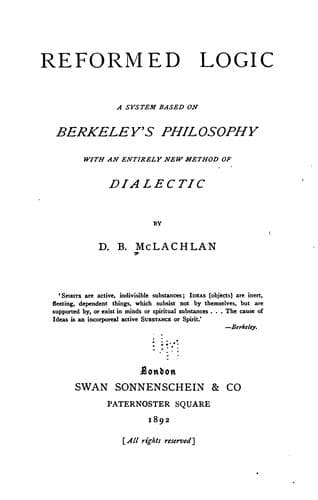
Reformed Logic: A System Based on Berkeley's Philosophy with an Entirely New Method of DialecticMcLachlan, D. B.
Philosophy
Reformed Logic: A System Based on Berkeley's Philosophy with an Entirely New Method of Dialectic
McLachlan, D. B.
Logic
III--DIFFERENCES BETWEEN SUBSTANTIAL AND METAPHYSICAL LOGIC
All the current academic metaphysic is ideal. Materialists, when they
attempt to explain thought, fail to attach it properly to the body,
or to account for that large and important division of mental activity
which has no bearing, direct or indirect, on bodily welfare. They drop
their materialism at an early stage of their enquiry and continue on
the metaphysical method.
Hence in none of the current systems is there any true principle of
arrangement in the treatment of logical phenomena. Unless we know the
use of a thing we cannot describe it, let alone explain it. We
know not the relative importance of its parts, and we arrange them
according to superficial resemblances, or on some arbitrary principle
which conceals instead of revealing their meaning.
Substantial philosophy alone possesses a principle of coherence. The
facts of consciousness are determined by anterior facts of substance,
and there can be only one true mode in which to present them--they
must follow and reflect the substantial order. They will thus appear
as a consecutive and coherent system of ideas, no one of which could
be otherwise placed without damage to the whole. This is perhaps the
most important respect in which substantial logic differs from others.
The doctrine of Categories has to receive full development in order
to elucidate the genesis of the 'material world.' Except to a
substantialist the categories have no particular value, and so they
are barely mentioned in the academic systems.
The theory of Reasoning or Dialectic (logic in the narrower sense)
given in the following chapters, will be found totally different from
the academic. It does not merely state in other words or metaphors the
doctrines laid down in works of the Aristotelian type,--it declares
that the theory of reasoning taught in these works is altogether
false. Our argumentation is not conducted in syllogisms, either tacit
or explicit. This has been suspected by several critics of logic,
but no attempt has been made to substitute a more correct theory and
method. Of course logicians do not always reason wrongly, and true
arguments may be stated in the syllogistic form. What I mean is
that logicians nowhere tell us in what right reasoning essentially
consists, and for want of a distinct notion on the subject they all of
them occasionally admit as valid, arguments that are not so.
The main dogma of substantialism should be kept in view in reading the
following pages. It is mind alone that is conceived as having solidity
and energy: material things are temporary forms of our consciousness;
they have length and breadth but no depth, and they are without
energy, even passive resistance. If an object cannot be removed at
pleasure, what resists us is the other mind causing that object, not
the object itself.
Public-domain text, read in full here on John Shaqi.
Reviews
Reviews
No reviews yet
Be the first to share your thoughts on this work.
Join the Discussion
Join the discussion
Sign in to leave a comment or review.
Sign InorCreate an account