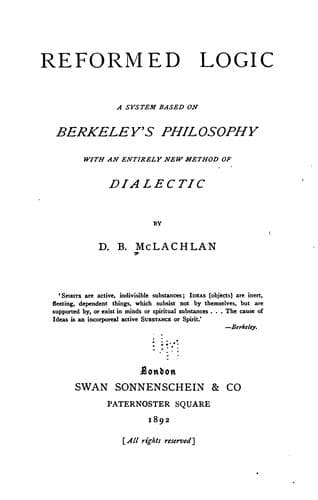
Reformed Logic: A System Based on Berkeley's Philosophy with an Entirely New Method of Dialectic — John Shaqi
Reformed Logic: A System Based on Berkeley's Philosophy with an Entirely New Method of DialecticMcLachlan, D. B.
Philosophy
Reformed Logic: A System Based on Berkeley's Philosophy with an Entirely New Method of Dialectic
McLachlan, D. B.
Logic
The beauty of the starry sky is irrelevant to the question. Apart from
the finite life and thought that may be associated with the stars,
they have no more philosophical importance than a spadeful of sand.
A more reasonable account of the inorganic is found in several ancient
philosophies. Gnostics and Neo-Platonists referred the elemental to
a cosmic mind (_Demiurgos_) intermediate between human beings and the
Supreme. The demiurgic mind is inconceivably greater and more powerful
than the human, but is not necessarily better in quality. It is the
origin of all natural forces, and its organic processes are what
we term 'physical laws.' This is the explanation of inorganic
consciousness which I feel disposed to adopt, but to discuss it fully
would carry us too far from the subject of this work.
The next point relates to the body. What is its function in
substantialism? The brain, says Berkeley, is an idea in the mind, and
he ridicules the notion that one idea should generate all other
ideas. This is an argument against materialism. No doubt he would have
admitted, though he does not say so, that the body-idea facilitates,
or at least must precede, the experience of other ideas. He would not
have denied that it is an _instrumental_ idea.
Since his time an important discovery has been made with reference to
the constitution of the body. I allude to the Cell theory. It is no
longer possible to regard the body either as a self-moving machine (if
this is not a contradiction in terms), or as a lump of 'dead matter'
animated by the mind. It is a society of minute animals[2], each
having a certain degree of independent energy and liberty of movement.
They are organised and governed by the human or animal mind with which
they are associated. In short, the relation of the cell to the man is
analogous to, if not quite the same as, the relation of the man to the
cosmic being.
This discovery complicates the problem of 'external' consciousness,
without however affecting the principles on which a substantialist
would endeavour to solve it. Instead of conceiving human minds as
coming into immediate contact in perception, we have to conceive the
cellular systems of each as forming a medium between the two. We
do not perceive the other mind immediately or intuitively; what we
perceive intuitively is certain affections in our own organism, which
we must first refer to the other body, and then to the mind behind
that body. Our knowledge of other human beings is thus altogether
inferential.
The cellular medium explains why we are not generally aware of
the substantial constitution of other minds; it is veiled by the
intervening organisms.
The relation of body to mind, the reason of embodiment, and so forth,
are questions of prime importance in ontology, but in logic we are
concerned only with the object in consciousness, without reference to
the apparatus of perception. The instrument of intellectual perception
may in its proper character be ignored.
Public-domain text, read in full here on John Shaqi.
Reviews
Reviews
No reviews yet
Be the first to share your thoughts on this work.
Join the Discussion
Join the discussion
Sign in to leave a comment or review.
Sign InorCreate an account