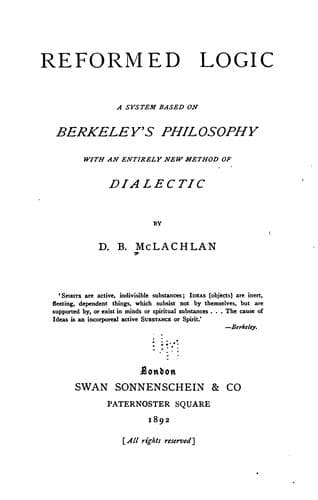
Reformed Logic: A System Based on Berkeley's Philosophy with an Entirely New Method of DialecticMcLachlan, D. B.
Philosophy
Reformed Logic: A System Based on Berkeley's Philosophy with an Entirely New Method of Dialectic
McLachlan, D. B.
Logic
J. S. Mill and his followers go to the opposite extreme. They
study all the sciences and endeavour to master their methods of
reasoning--which is well; but they do so with the prepossession that
there exists some absolute standard of knowledge to fail in attaining
which involves fallacy. They thus condemn as false all theorems based
on superseded notions of nature and man. Only modern thinkers can
argue rationally--the ancients were all and habitually victims of
fallacy,--and of the moderns only the few are rational who have
mastered the latest theories on every subject. This is the principle
of Mill's doctrine on the fallacies of observation; we can see that
he regarded all beliefs as fallacious which he had himself outgrown
or did not feel a need of. 'Truth' was simply the facts and judgments
that happened to suit Mill's mental constitution.
From the Substantial point of view this is an untenable position.
No degree of observation is intrinsically defective if it serve
the purpose of intellect, which is to protect the mind. There is no
intellectual truth as a thing in itself. The thoughts of a sparrow or
a child are as perfect as those of a man, if they afford the necessary
defence to the individual's sentiment. As we change our inner mental
character, new intellectual ideas have to be acquired and the old
are discarded, perhaps completely forgotten. They appear now to be
ignorances and fallacies--mal-observation and bad reasoning. The
new seem to be so much truer--perhaps infallibly true. All that is
illusion. We make another advance, and the thoughts that a week before
were as stable as rocks are now cast aside as absurd. Perhaps the
belief in the certainty of present judgments is a condition of our
making the best use of them; if so they should not be shaken until we
are ready to enter on the next stage of knowledge.
It is quite true that one man may know more than another, but the
ground on which the more intellectual is generally considered to be
superior to the latter is not the right one. He is not better for his
intellectual acquirements, but he is better if his mind, being of a
finer sort, required a superior intellect to defend it. At bottom,
then, the general cause of mal-observation--there are particular
causes which interfere with the general rule--is inferiority of
sentimental character. We do not see what we do not need to see, and
we see imperfectly what is not essential to our well-being. That we
should be ignorant or reason badly about what does not concern us is
not in itself a defect.
It is inconsistent with these views on the function of intellect
to admit that any sort of non-observation or mal-observation can be
always and for all alike fallacious. If there are things which
we habitually ignore, the presumption is that they do not concern
us--that the knowledge they would confer is not essential to our
welfare and would be intellectual lumber.
Public-domain text, read in full here on John Shaqi.
Reviews
Reviews
No reviews yet
Be the first to share your thoughts on this work.
Elsewhere in the archive
Join the Discussion
Join the discussion
Sign in to leave a comment or review.
Sign InorCreate an account