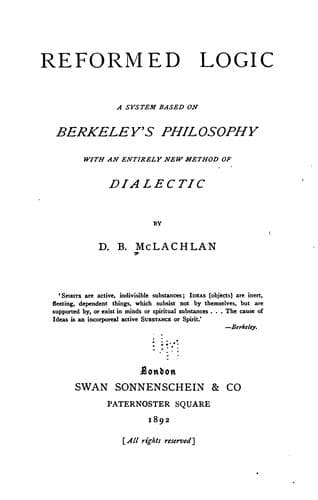
Reformed Logic: A System Based on Berkeley's Philosophy with an Entirely New Method of DialecticMcLachlan, D. B.
Philosophy
Reformed Logic: A System Based on Berkeley's Philosophy with an Entirely New Method of Dialectic
McLachlan, D. B.
Logic
I should therefore abstain from condemning as fallacies theorems
drawn in good faith from facts believed to be true, and which serve as
motives of conduct. They are sophisms only when the reasoners have not
taken ordinary pains to verify their data, or, knowing the antecedents
to be false, pretend to believe them for some immoral purpose.
XXX--OF PARALLEL ARRANGEMENT
There is no fault of perversion, mutilation, or entanglement in the
statement of an argument that we do not meet with in actual reasoning.
Even in the writings of educated and honest thinkers it is rare to
meet with an argument the parts of which are clearly distinguished by
the author himself, and expressed so as to show the precise degree of
force they ought to carry. Reasoning is still only a semi-conscious
process directed by rule-of-thumb. We make certain statements and find
they have a power of moving others, so we continue to make them.
But whether the result is due to the rationality of the discourse or
merely to the docility of the hearers, we do not know, and--so long as
the desired result follows--we do not care to inquire.
For this state of things logicians are to a great extent responsible.
They are uncritical imitators of the Greek philosophers, whose notions
on dialectic were quite wrong. The Greeks and their medieval and
modern followers have squandered attention on a mental process which
is not reason, mistaking it for reason, so that practically there has
never been a science of dialectic. However much reasoners may have
wished to present their thoughts coherently, they have not been
provided with a method or notation adapted to the purpose. With an
instinctive sense of the futility of the Syllogism, they have ignored
it completely. I cannot call to mind a single controversial work that
has been presented in syllogistic form, nor do even trained logicians
use it overtly in argument.[18] Yet if it were what it professes to
be, it would be as natural and convenient to express our arguments in
syllogism as it is to put down on paper a sum in arithmetic. We are,
as regards the expression of reasoning, in the position of numerical
thinkers before the invention of figures and the elaboration of
arithmetical rules. We have to do all our arguments 'in our head,' and
so we do them badly. We can seldom be sure of the correctness of
our own reasonings, and we are constantly being misled by sophistry.
Nothing indeed will enable us to reason well or to detect false
reasoning on a subject of which we are entirely ignorant, but a large
measure of protection would be afforded by the adoption of a uniform
system of presenting arguments, by which all the assumptions they
involve are rendered explicit.
Public-domain text, read in full here on John Shaqi.
Reviews
Reviews
No reviews yet
Be the first to share your thoughts on this work.
Elsewhere in the archive
Join the Discussion
Join the discussion
Sign in to leave a comment or review.
Sign InorCreate an account