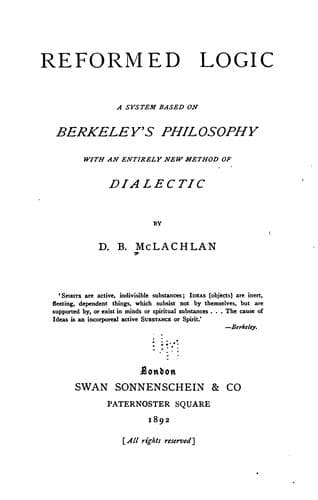
Reformed Logic: A System Based on Berkeley's Philosophy with an Entirely New Method of DialecticMcLachlan, D. B.
Philosophy
Reformed Logic: A System Based on Berkeley's Philosophy with an Entirely New Method of Dialectic
McLachlan, D. B.
Logic
From these considerations it follows that there are two sciences of
number. There is the true science which deals with quantities really
seen in objects and imagined in the mind, and an artificial science
dealing with figures which have only a historical connection with real
quantity. Of the latter, unfortunately, our arithmetical education
chiefly consists. We are never taught to distinguish number and size
in things by the 'eye,' that is, by reason. The symbolism that was
originally intended to assist real arithmetical thought has ended by
supplanting it. An ignorant shepherd, bricklayer, or carpenter, who is
accustomed to make a rapid estimate of the number of things in a
mass, or the area of planking in a log, has a better training in real
arithmetical science than some mathematicians. If we are obliged to
practise genuine arithmetical thought in engineering, astronomy, and
other professions, our scholastic symbolism gets realised to some
extent, and is a great assistance in arithmetical estimation. But
without this it has no more reference to number and quantity than a
musical education, based entirely on the printed or written notation,
has to the appreciation of musical sounds. A book arithmetician is in
the position of a person thoroughly acquainted with theoretical music,
and who can even compose music _according to rule_, but who is unable
to distinguish a high note from a low one or harmony from discord in
actual sound.
It will thus be seen that it is only in the real arithmetic that
reasoning can enter. The judgment in free arithmetical observation is
the counting of actual groups and the measurement of actual surfaces,
and the argument consists in estimating the number of individuals
in other groups, and the size of other surfaces, without counting or
measurement. But this exercise never enters into symbolic arithmetic.
All the apparent conclusions of book arithmetic are tautological; they
consist in repeating in one combination of symbols the whole or
part of what has been already given in another combination. It is an
exercise in expression--nothing more.
Arithmetical ratio has a resemblance to the rational parallel.
3:5::9:15 might be arranged thus--
5 | 15
--+---
3 | 9
This is not argument, for two reasons. (1) The apparent conclusion
is not an effort of rational imagination; it is a figure that can
be obtained with infallible certainty by treating the other figures
according to a rule, which has only to be recollected and applied. (2)
The relation between the left-hand figures and the right-hand figures
is not a categorical judgment; it is a form of resemblance, and so it
cannot yield a valid conclusion.
XXXIV--GEOMETRICAL DEMONSTRATION
This exercise is regarded by logicians as one of the purest forms
of argument. It is nothing more than an aid to a certain kind of
perception.
Public-domain text, read in full here on John Shaqi.
Reviews
Reviews
No reviews yet
Be the first to share your thoughts on this work.
Elsewhere in the archive
Join the Discussion
Join the discussion
Sign in to leave a comment or review.
Sign InorCreate an account