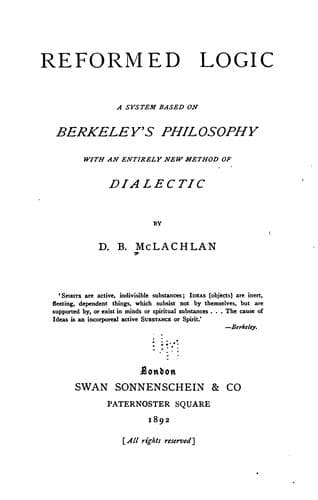
Reformed Logic: A System Based on Berkeley's Philosophy with an Entirely New Method of DialecticMcLachlan, D. B.
Philosophy
Reformed Logic: A System Based on Berkeley's Philosophy with an Entirely New Method of Dialectic
McLachlan, D. B.
Logic
Take, for instance, the fifth proposition of the first book of
Euclid--'The angles at the base of an isosceles triangle are equal,
and if the equal sides be produced the angles on the other side shall
also be equal.' The proposition is accompanied by a diagram of an
isosceles triangle with the equal sides already produced, so that
the conditional phrasing of the proposition does not mean that the
production of the sides, and what results therefrom, are future
or possible events which neither Euclid nor anybody else has yet
experienced, and the probability of which is an argumentative
conclusion.
What the proposition means is this: an isosceles triangle of which the
equal sides have been produced, has equal angles on the same side of
the base both within and without the triangle. It is an affirmation of
what is, not of what we must believe to be for reasons to be given.
The truth of the proposition is seen at once from simple inspection of
the diagram. It is an association of properties related in a certain
manner. It has many relations which the geometer does not mention in
this proposition, but those which he mentions are seen to be correctly
described as soon as we direct attention to them. If we have any doubt
on the subject we remove it by measuring the angles.
Euclid however does not appeal to the powers of inspection we can
exercise in this case, and he ignores our facilities for measurement.
He appeals to simpler and easier kinds of perception expressed in
his axioms, which he began by assuming we were capable of exercising
without demonstration. They constitute what he considers the minimum
power of relational perception, which if a man have not he cannot be
taught geometry. Euclid also in this proposition refers to the result
of a prior demonstration, the relation in which he supposes we have
seized. By means of these antecedents he _prompts_ our perceptive
faculty up to the point of seeing the relations expressed in this
proposition. If we saw them without the prompting, the latter is
superfluous; if the relations do not stand the test of measurement,
the prompting goes for nothing.
All Euclid's demonstrations are of this sort. They are pointings-out
of what can be seen by inspection and sufficient attention. He is
not bringing a case under a precedent--he is describing relations in
things, that may serve as precedents in concrete or applied geometry.
The service he performs is that of a connoisseur who points out the
beauties of a picture or landscape to a careless or uninterested
spectator. Relations are sometimes difficult to see--much more
difficult than colours or masses--and there is a legitimate sphere of
usefulness for people who point out what others are apt to overlook.
There is no prediction in this. We are not asked to conceive anything
that is not before us. Geometrical demonstration thus assists
perception, but does not imply reasoning. Euclid does not argue--he
prompts.
Public-domain text, read in full here on John Shaqi.
Reviews
Reviews
No reviews yet
Be the first to share your thoughts on this work.
Elsewhere in the archive
Join the Discussion
Join the discussion
Sign in to leave a comment or review.
Sign InorCreate an account