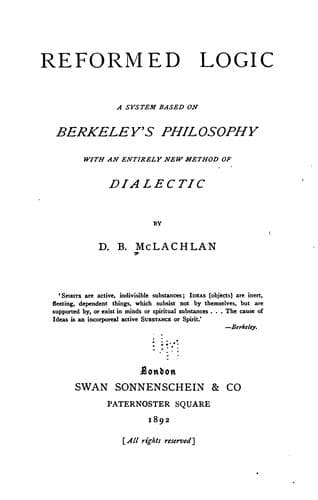
Reformed Logic: A System Based on Berkeley's Philosophy with an Entirely New Method of DialecticMcLachlan, D. B.
Philosophy
Reformed Logic: A System Based on Berkeley's Philosophy with an Entirely New Method of Dialectic
McLachlan, D. B.
Logic
Those who maintain that Euclid is syllogistic do so on the ground
that the axioms are generalisations, and that as often as one is cited
there occurs the subsumption of an object under a class-notion. That
would not be argument; but let us suppose it means bringing a
case under a precedent. Then if the axioms be precedents and the
demonstration an application of them to new cases, the theorem is a
fallacy--a useless argument written to prove a foregone certainty,
for the conclusion can be and generally is perfectly known without
reference to the demonstration.
It appears to me more true to regard the axioms as the simplest
relations, which everybody may be supposed capable of perceiving,
and that geometrical demonstration consists in showing that other
relations not so apparent are really varieties or combinations of the
simpler relations. By using in concert with the axioms the relations
already demonstrated, we are enabled to grasp relations that would not
have been at all obvious on first beginning the geometrical praxis.
Euclid's geometry is thus a series of graduated lessons in a special
sort of observation, not a system of deductive arguments.
The educational theory that geometry is exceptionally good training
for the reason--apart from its practical utility in mechanics--is thus
evidently a mistake. Abstract geometry may induce habits of minute
observation and exact definition, but reason nowhere enters into the
study. As a rational gymnastic there is nothing better than the game
of chess.
XXXV--INDUCTION
Those who contend that there is a kind of argument called Inductive
different from the Deductive, illustrate their view by some such
example as the following:--'This, that, and the other magnet' [that
is, all the magnets we know] 'attract iron; therefore all possible
magnets attract iron.' They say there is an irresistible compulsion
in the mind to draw such a conclusion from information of the kind
exemplified, and they contrast that type of thought with a deductive
argument like--'All magnets attract iron; this object is a magnet;
therefore it attracts iron.' They figure the former as a progress
upwards, the latter as a regress downwards.
That is Induction as understood by J. S. Mill and Sir William
Hamilton; on this point these philosophers happen to agree.
The first of those arguments is a deduction with the precedent
omitted. Expressed in full it amounts to this--'Any relation
observed several times to subsist between two classes of objects, and
concerning which no exception has ever been observed, may be taken as
universal; there is such a relation between known magnets and known
iron; therefore it may be regarded as universal.' The precedent is not
a mental compulsion, but a result of experience. Induction as above
defined is therefore only a species of deductive conclusions.
Public-domain text, read in full here on John Shaqi.
Reviews
Reviews
No reviews yet
Be the first to share your thoughts on this work.
Elsewhere in the archive
Join the Discussion
Join the discussion
Sign in to leave a comment or review.
Sign InorCreate an account