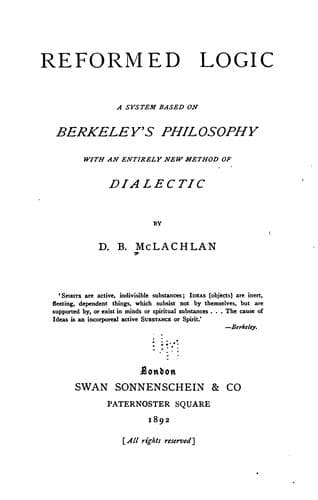
Reformed Logic: A System Based on Berkeley's Philosophy with an Entirely New Method of DialecticMcLachlan, D. B.
Philosophy
Reformed Logic: A System Based on Berkeley's Philosophy with an Entirely New Method of Dialectic
McLachlan, D. B.
Logic
Most logicians take the word Induction in its etymological sense, as
meaning systematic observation carried on with a view to obtaining
a general idea of some class of objects; or of establishing a
categorical relation between one object or class and another, by
eliminating all the alternative correlatives. In neither operation
would Induction be argument.
In science a 'perfect induction' is one in which all existing objects
of a class, or all objects related in a certain manner, have been
perceived, so that there is no other object concerning which a
conclusion can be drawn. In such cases, says Mill, there is no
induction--only a summary of experience. He evidently regarded the
conclusion with respect to unknown cases as the essence of induction,
whereas in the scientific sense the induction is the positive content
of the idea, or the abstract relation--the unknown cases are ignored,
or there may be none. In scientific writings induction sometimes means
the _method_ of observation rather than the result--the method of
correcting inferences by perception, wherever possible.
XXXVI--ARISTOTLE'S DICTUM
This is usually put into English thus--'Whatever is affirmed or denied
of a class, may be affirmed or denied of any part of that class,'
and such an affirmation or denial is supposed to be an act of reason.
Archbishop Whately expounds the Dictum in analysing the following
theorem--Whatever exhibits marks of design had an intelligent author;
the world exhibits marks of design; therefore the world had an
intelligent author.
'In the first of these premises,' he says, 'we find it assumed
universally of the _class_ of "things which exhibit marks of
design," that they had an intelligent author; and in the other
premise, "the world" is referred to that class as comprehended
in it: now it is evident that whatever is said of the whole of
a class, may be said of anything comprehended in that class:
so that we are thus authorised to say of the world, that "it
had an intelligent author." Again, if we examine a syllogism
with a negative conclusion, as, _e.g._ "nothing which exhibits
marks of design could have been produced by chance; the
world exhibits, &c.; therefore the world could not have been
produced by chance:" the process of Reasoning will be found
to be the same; since it is evident, that whatever is _denied_
universally of any class may be denied of anything that is
comprehended in that class. On further examination it will be
found, that all valid arguments whatever may be easily reduced
to such a form as that of the foregoing syllogisms; and that
consequently the principle on which they are constructed is
the UNIVERSAL PRINCIPLE of Reasoning.'[20]
Public-domain text, read in full here on John Shaqi.
Reviews
Reviews
No reviews yet
Be the first to share your thoughts on this work.
Elsewhere in the archive
Join the Discussion
Join the discussion
Sign in to leave a comment or review.
Sign InorCreate an account