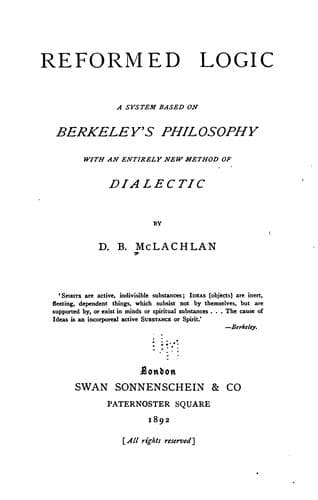
Reformed Logic: A System Based on Berkeley's Philosophy with an Entirely New Method of DialecticMcLachlan, D. B.
Philosophy
Reformed Logic: A System Based on Berkeley's Philosophy with an Entirely New Method of Dialectic
McLachlan, D. B.
Logic
The examples given by Whately are perfectly valid; the first is a
constructive argument in the Sixth Category, the second a stigmatic
in the Fifth. I have in several places admitted that the arguments
adduced by syllogists are sometimes correct, the fault complained of
being in the mode in which such correct arguments are interpreted.
They are interpreted wrongly, and then other theorems are found or
made agreeing with the _interpretation_, and the admitted soundness
of the first theorems is used to procure acceptance for the second.
Things brought under the same definition ought to be essentially
alike, but they are not so when the utmost latitude is taken to
'assume' that predicates have properties which they obviously have
not.
The objections we make to the Dictum as above interpreted are--(1)
that in reasoning the precedent (major premise) need not be a class;
(2) if it is a class, it consists of all _known_ things of a similar
kind, not of all _possible_ things of a similar kind. When interpreted
in the latter sense the Dictum becomes dialectically tautological, as
has been often observed.
XXXVII--MEDIATE COMPARISON
A few pages further on Whately gives a totally different account of
reasoning, without being aware of his inconsistency.
'Every syllogism has three, and only three terms: viz. the
middle term and the two terms (or extremes, as they are
commonly called) of the Conclusion or Question. Of these,
first, the subject of the conclusion is called the _minor_
term; second, its predicate, the _major_ term; and third, the
_middle_ term, (called by the older logicians "Argumentum") is
that with which each of them is separately compared, in order
to judge of their agreement or disagreement with each other.
If therefore there were two middle terms, the extremes or
terms of conclusion not being both compared to the same, could
not be conclusively compared to each other.'[21]
Here reasoning is made to consist in comparing two things by
reference to a third which both resemble. There is not a word about
classification, which is declared just before--in loud capitals--to be
the universal principle of reasoning!
On this definition we remark--
(1) Comparison by mediation is untrustworthy, unless the qualities
compared be rigidly defined or restricted, as in geometry and the use
of standards (XXII). In geometry the only two qualities recognised
are figure and magnitude. The axiom of mediate comparison means that
things having the same magnitude as a third thing are to be considered
equal, though they may have different outlines. But the axiom is
liable to be untrue in things of three or more qualities. Add colour.
Then a white sphere may resemble a white cube on the one side, and a
black sphere on the other, but the white cube does not at all resemble
the black sphere. This axiom is therefore inadmissible or at
least extremely risky in logic, which treats of things having many
qualities.
Public-domain text, read in full here on John Shaqi.
Reviews
Reviews
No reviews yet
Be the first to share your thoughts on this work.
Elsewhere in the archive
Join the Discussion
Join the discussion
Sign in to leave a comment or review.
Sign InorCreate an account