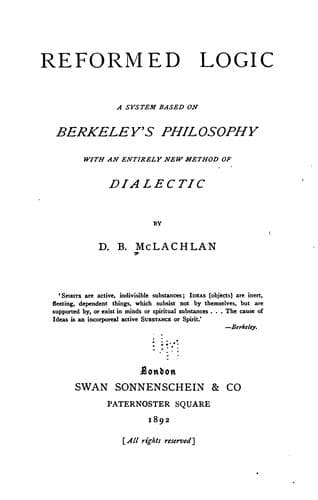
Reformed Logic: A System Based on Berkeley's Philosophy with an Entirely New Method of DialecticMcLachlan, D. B.
Philosophy
Reformed Logic: A System Based on Berkeley's Philosophy with an Entirely New Method of Dialectic
McLachlan, D. B.
Logic
(2) Comparison, however correctly performed, is never the end, but
only a means, of reasoning.
XXXVIII--SYLLOGISM
We have already had two distinct definitions of syllogism. According
to the first it is the application of class-attributes to individuals
known to belong to the class; according to the second it is the
comparison of two things or terms by reference to a third which both
resemble. When we arrive at the chapters in logic books devoted to the
exposition of the syllogism in detail, we find that the theorems there
discussed do not conform to either of those definitions. The only
sort of syllogism that can be 'converted' is one consisting of two
classifications, and a conclusion which predicates a classification,
as thus--
_All Englishmen are Europeans;
John Smith is an Englishman;
therefore John Smith is a European._
Observe the difference between this theorem and that adduced in
illustration of the Dictum (XXXVI). In the latter the first premise
is a categorical judgment and so therefore is the conclusion; in the
theorem just given the first premise is a classification, and the
conclusion is necessarily a classification.
We first remark that such an 'argument' is never met with in
real spontaneous thinking--it occurs only in logic books. It is
manufactured exclusively for Peripatetic consumption. The reason it
is not to be found is simple--the conclusion it yields is a
classification, and that is not enough for valid argument.
In reasoning we may introduce a classification as the _minor
premise_--that is, the proposition which brings the case under the
precedent--but the applicate is never a general or class idea. It is
one or more properties abstracted from the subject (whether the latter
be a single object or general idea), and applied to the case. Merely
to classify a case and so leave it would answer no rational purpose.
Logicians urge in recommendation of this syllogism that it gives a
certain conclusion. The premises being correct, the conclusion is
infallibly true.
No doubt it is, for in contemplating a thing we can mentally enter it
into all the classes to which it appears to belong, whatever be their
generality. Knowing the class European and the individual John Smith,
we see at once that the latter is contained in the former, and we can
do this without putting him first in the minor class English. It is
like saying, 'The pavilion is in the garden, John Smith is in the
pavilion, therefore he is in the garden.' Of course he is! The minor
premise of a double classification is superfluous. The fact that
such conclusions are certain, shows how nugatory they are. We are
not certain of anything till it has been experienced. In legitimate
reasoning the conclusion is never more than probable. The certainty of
these double classifications shows that we are stating what we already
know--not imagining an ideal addition to our positive knowledge.
Public-domain text, read in full here on John Shaqi.
Reviews
Reviews
No reviews yet
Be the first to share your thoughts on this work.
Elsewhere in the archive
Join the Discussion
Join the discussion
Sign in to leave a comment or review.
Sign InorCreate an account