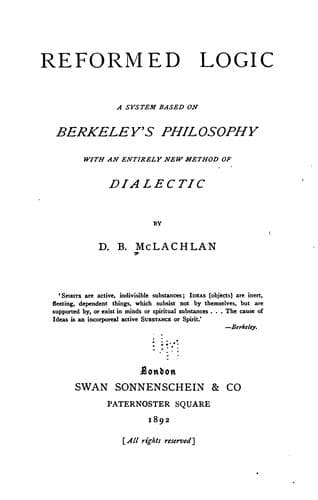
Reformed Logic: A System Based on Berkeley's Philosophy with an Entirely New Method of DialecticMcLachlan, D. B.
Philosophy
Reformed Logic: A System Based on Berkeley's Philosophy with an Entirely New Method of Dialectic
McLachlan, D. B.
Logic
_Doctrine of the Predicate._ So long as logicians are permitted to
fabricate their own examples, all is plain sailing with the syllogism.
But they are sometimes obliged to deal with genuine arguments. In
this case what they do is to assume that _for logical purposes_ every
predicate of the precedent--that is, the applicate--is a general or
class term. Even when an argument is good they spoil it with a bad
theory.
Sir William Hamilton states that up to his time logicians recognised
but one type of proposition--that called by him the proposition 'in
extension,' which means the classifying of the subject. He announced
that he intended to introduce a proposition 'in comprehension,'
meaning a judgment in the category of inherence--as for instance, 'man
is responsible.' He further said that he recognised a third type of
proposition, that concerning 'cause and effect.'
But in the course of working out these logical novelties he seems to
have discovered that they were irreconcilable with conversion, and so
he dropped them. The judgment in comprehension, he then declared, was
to all intents and purposes the same as one in extension, and as to
causation--why, a cause is a class, and an effect is an individual
belonging to that class![22]
Let us see what is the result of treating applicates as general ideas.
Take an example in each of the categories.
'The paper is white.' This means that the paper has the property or
attribute of whiteness. In logic it is interpreted to mean that paper
is an individual of the class _white_. This is wrong, for there is no
such class. No sane person would form a class out of salt, snow, milk,
china, silver, the moon, and other white things; for though they have
a common property it is not the sign of a common human utility.
The confusing a single property with a class is not always owing to
exigencies of syllogism. It pervades the writings of most Western
metaphysicians, and may be accounted for in this manner.
General ideas and abstract properties or ideas have in common that
they are _partial_ recognitions of what we perceive (XIV). The
partition in each is however made in a different way, and for a
different purpose. In generalisation the selection is done almost
mechanically. We see many things that have some common relation,
function, or utility for us, and we remember only so much of them
as appears to be necessary for the recognition of that relation or
utility--just so much of the Intellectual experience as has always
accompanied the Sentimental experience. The process is very like that
of putting a piece of wood or ivory in a turning-lathe, and whittling
off all that we do not want. A general idea is the useful core of
a multitude of superposed observations, each of which had something
irrelevant--something which it is better to forget. We whittle this
off and remember only the core.
Public-domain text, read in full here on John Shaqi.
Reviews
Reviews
No reviews yet
Be the first to share your thoughts on this work.
Elsewhere in the archive
Join the Discussion
Join the discussion
Sign in to leave a comment or review.
Sign InorCreate an account