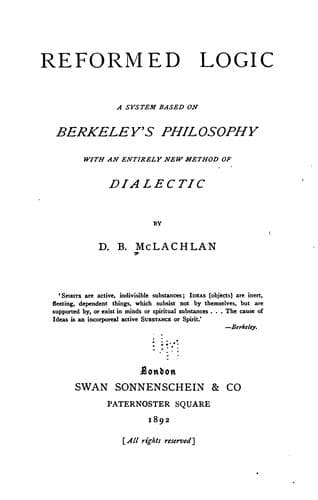
Reformed Logic: A System Based on Berkeley's Philosophy with an Entirely New Method of DialecticMcLachlan, D. B.
Philosophy
Reformed Logic: A System Based on Berkeley's Philosophy with an Entirely New Method of Dialectic
McLachlan, D. B.
Logic
Abstraction, on the other hand, is a conscious and deliberate
operation from beginning to end. It consists in distinguishing one by
one the properties of a thing, and even treating each property as if
it had an independent existence. For this exercise it is not
necessary to observe many things: we can analyse one alone, though an
acquaintance with other cognate objects is sometimes necessary to call
our attention to single properties. We need the shock of difference to
be able to distinguish well a fine abstraction--the difference between
shades of colours, for example. Abstraction is thus a minute
attention to individuals, and need not for a moment be confounded with
generalisation.
Another cause of the confusion in question can be traced to the use of
the verb 'is' to represent both the relation of a thing to the general
idea it has contributed to form, and the relation of a single property
to the thing in which it inheres. We say 'The man _is_ a British
subject'--classifying him; we say also 'The man _is_ cold'--mentioning
one of his attributes. There is no class of cold men, and the two
relations have nothing in common. A class does not inhere in a man as
cold inheres in him. There is no _object_ corresponding to class--it
is a conceptual creation.
The ambiguity of 'is' favours the syllogistic doctrine of predication,
and there is a rule to the effect that in syllogising propositions,
all verbs are to be converted into 'is' (or its conjugates) with a
participle or noun, so that if they were not before statements
of classification they now become such. 'He walks' is clearly no
classification; but 'he is walking' is assimilated by false analogy
to such a classification as 'he is human,' and so is treated as a
classification by those who reason according to the Letter.
The substantive verb has no positive and uniform meaning. As an
auxiliary it is a mere sign of tense, and in other positions it is an
indefinite mark of relationship, the precise meaning of which must
be determined by the subject and the context. It may sometimes be
dispensed with in classification, as 'Victoria Regina'--'Phillips,
Dentist.'
In the second category we have such propositions as 'the book lies on
the table.' In syllogistic this is first altered to 'the book is lying
on the table,' and it is feigned that 'lying on the table' is a class
or general idea, and 'book' an individual of that class. To interpret
'the groom stands by the horse' a class has to be created, composed of
the persons who happen to be standing by horses.
'The mountain is ten miles off' is a judgment in perspection.
Syllogistically we are asked to believe that a class of things exists
having the common property of being ten miles off, and that the
mountain is entered in that class. The absurdity of this doctrine is
self-evident.
Public-domain text, read in full here on John Shaqi.
Reviews
Reviews
No reviews yet
Be the first to share your thoughts on this work.
Elsewhere in the archive
Join the Discussion
Join the discussion
Sign in to leave a comment or review.
Sign InorCreate an account