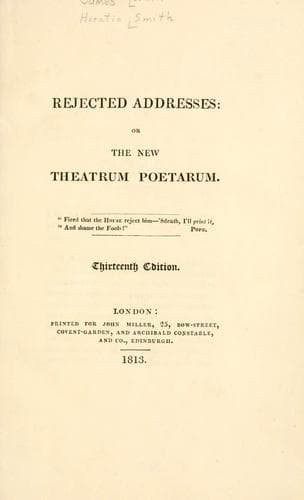
Rejected Addresses; Or, The New Theatrum PoetarumSmith, James
General
Rejected Addresses; Or, The New Theatrum Poetarum
Smith, James
Parodies
To the credit of the _genus irritabile_ be it recorded, that not one of
those whom we had parodied or burlesqued ever betrayed the least soreness
on the occasion, or refused to join in the laugh that we had occasioned.
With most of them we subsequently formed acquaintanceship; while some
honoured us with an intimacy which still continues, where it has not been
severed by the rude hand of Death. Alas! it is painful to reflect, that
of the twelve writers whom we presumed to imitate, five are now no more;
the list of the deceased being unhappily swelled by the most illustrious
of all, the _clarum et venerabile nomen_ of Sir Walter Scott! From that
distinguished writer, whose transcendent talents were only to be equalled
by his virtues and his amiability, we received favours and notice, both
public and private, which it will be difficult to forget, because we had
not the smallest claim upon his kindness. “I certainly must have written
this myself!” said that fine-tempered man to one of the authors, pointing
to the description of the Fire, “although I forget upon what occasion.”
Lydia White, {0g} a literary lady who was prone to feed the lions of the
day, invited one of us to dinner; but, recollecting afterwards that
William Spencer {0h} formed one of the party, wrote to the latter to put
him off, telling him that a man was to be at her table whom he “would not
like to meet.” “Pray, who is this whom I should not like to meet?”
inquired the poet. “O!” answered the lady, “one of those men who have
made that shameful attack upon you!” “The very man upon earth I should
like to know!” rejoined the lively and careless bard. The two
individuals accordingly met, and have continued fast friends ever since.
Lord Byron, too, wrote thus to Mr. Murray from Italy—“Tell him I forgive
him, were he twenty times over our satirist.”
It may not be amiss to notice, in this place, one criticism of a
Leicestershire clergyman, which may be pronounced unique: “I do not see
why they should have been rejected,” observed the matter-of-fact
annotator; “I think some of them very good!” Upon the whole, few have
been the instances, in the acrimonious history of literature, where a
malicious pleasantry like the _Rejected Addresses_—which the parties
ridiculed might well consider more annoying than a direct satire—instead
of being met by querulous bitterness or petulant retaliation, has
procured for its authors the acquaintance, or conciliated the good-will,
of those whom they had the most audaciously burlesqued.
Public-domain text, read in full here on John Shaqi.
Reviews
Reviews
No reviews yet
Be the first to share your thoughts on this work.
Join the Discussion
Join the discussion
Sign in to leave a comment or review.
Sign InorCreate an account