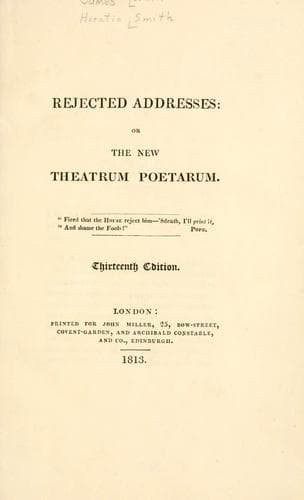
Rejected Addresses; Or, The New Theatrum PoetarumSmith, James
General
Rejected Addresses; Or, The New Theatrum Poetarum
Smith, James
Parodies
Upon the propriety of this plan men’s minds were, as they usually are
upon matters of moment, much divided. Some thought it a fair promise of
the future intention of the Committee to abolish that phalanx of authors
who usurp the stage, to the exclusion of a large assortment of dramatic
talent blushing unseen in the background; while others contended that the
scheme would prevent men of real eminence from descending into an
amphitheatre in which all Grub Street (that is to say, all London and
Westminster) would be arrayed against them. The event has proved both
parties to be in a degree right, and in a degree wrong. One hundred and
twelve _Addresses_ have been sent in, each sealed and signed, and
mottoed, “as per order,” some written by men of great, some by men of
little, and some by men of no talent.
Many of the public prints have censured the taste of the Committee, in
thus contracting for _Addresses_ as they would for nails—by the gross;
but it is surprising that none should have censured their _temerity_.
One hundred and eleven of the _Addresses_ must, of course, be
unsuccessful: to each of the authors, thus infallibly classed with the
_genus irritabile_, it would be very hard to deny six stanch friends, who
consider his the best of all possible _Addresses_, and whose tongues will
be as ready to laud him as to hiss his adversary. These, with the potent
aid of the bard himself, make seven foes per address; and thus will be
created seven hundred and seventy-seven implacable auditors, prepared to
condemn the strains of Apollo himself—a band of adversaries which no
prudent manager would think of exasperating.
But, leaving the Committee to encounter the responsibility they have
incurred, the public have at least to thank them for ascertaining and
establishing one point, which might otherwise have admitted of
controversy. When it is considered that many amateur writers have been
discouraged from becoming competitors, and that few, if any, of the
professional authors can afford to write for nothing, and, of course,
have not been candidates for the honorary prize at Drury Lane, we may
confidently pronounce that, as far as regards _number_, the present is
undoubtedly the Augustan age of English poetry. Whether or not this
distinction will be extended to the _quality_ of its productions, must be
decided at the tribunal of posterity; though the natural anxiety of our
authors on this score ought to be considerably diminished when they
reflect how few will, in all probability, be had up for judgment.
Public-domain text, read in full here on John Shaqi.
Reviews
Reviews
No reviews yet
Be the first to share your thoughts on this work.
Join the Discussion
Join the discussion
Sign in to leave a comment or review.
Sign InorCreate an account